How NATO distinguishes a routine nuclear drill from escalation
On Oct. 8, NATO officials confirmed that the annual Steadfast Noon nuclear exercise would begin in Italy the following week.
NATO officials said Steadfast Noon would start on Tuesday, run for 10 days and potentially involve dozens of aircraft from 17 member countries, with Italy hosting. [5] The exercise follows a Russian warning about using nuclear weapons if its territory comes under threat, but NATO's Head of Nuclear…
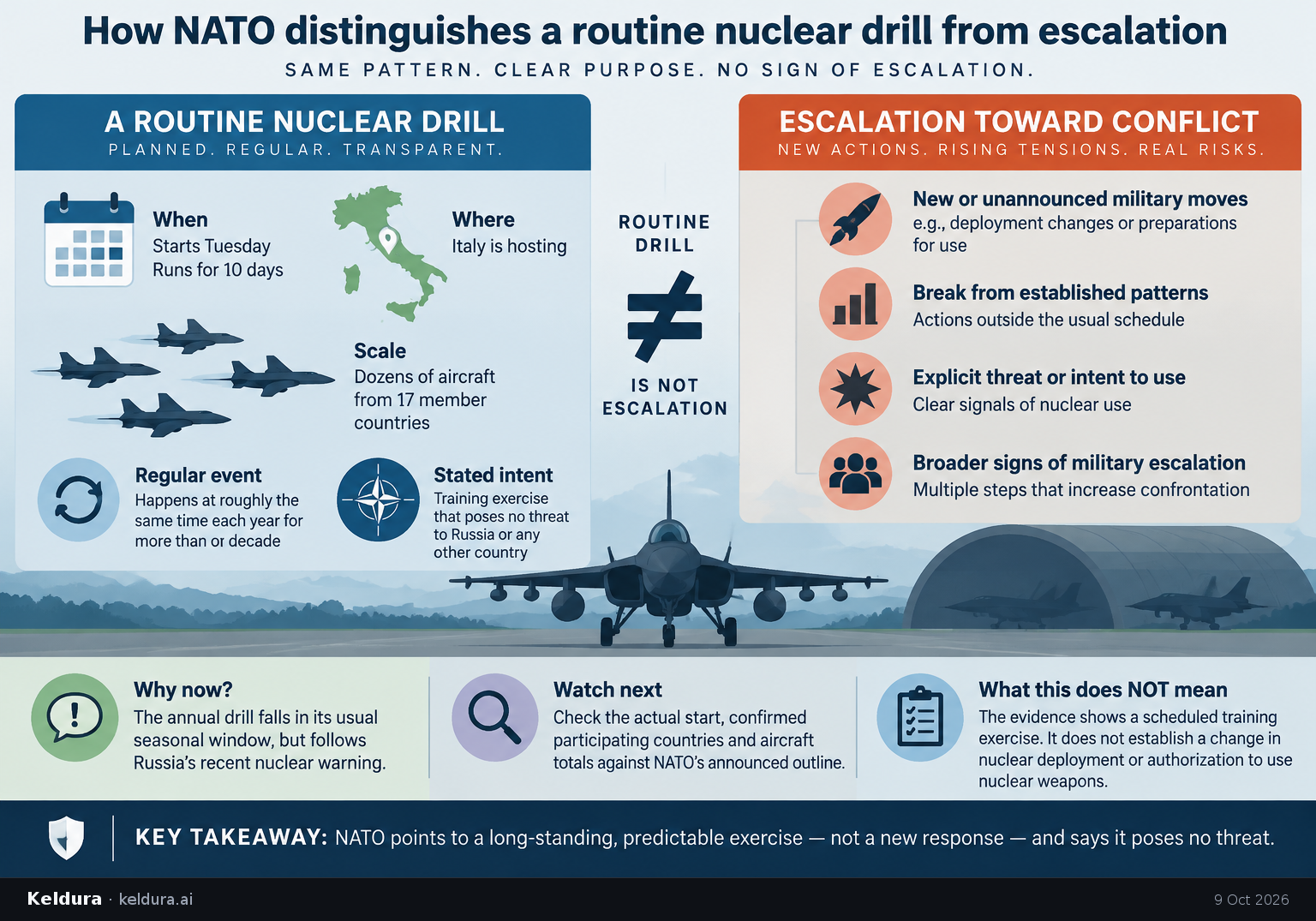
NATO officials said Steadfast Noon would start on Tuesday, run for 10 days and potentially involve dozens of aircraft from 17 member countries, with Italy hosting. [5] The exercise follows a Russian warning about using nuclear weapons if its territory comes under threat, but NATO's Head of Nuclear Policy, Nassima Barrows, said the drill poses no threat to Russia or any other country. [5]
Why it matters: The distinction is between an established training schedule and its heightened political context. NATO says the exercise has occurred at roughly the same time each year for more than a decade, making that regularity central to its reassurance message after Russia's warning. [5]
Key insights: The announced scale is multinational: aircraft from 17 NATO countries could participate over a 10-day period. [5] | NATO emphasizes predictability rather than presenting the exercise as a newly created response to Russia. [5] | The evidence establishes the schedule and NATO's stated intent; it does not establish a change in nuclear deployment or authorization to use nuclear weapons. [5]
Cheatsheet facts: What changed: NATO confirmed the next Steadfast Noon exercise: Italy hosting, a Tuesday start and a 10-day duration. [5] | Why now: The annual drill falls in its usual seasonal window, but follows Russia's recent nuclear warning. [5] | Watch next: Check the exercise's actual start, confirmed participating countries and aircraft totals against NATO's announced outline. [5]