How England’s controlled-chaos experiment could shape Euro 2028
Thomas Tuchel recalled Cole Palmer and Trent Alexander-Arnold on Friday as England began its post-World Cup transition toward Euro 2028.
Tuchel named Palmer and Alexander-Arnold in a 27-player Nations League squad but said recalled players still have to perform.[6][8] After England’s 2-1 World Cup semifinal defeat by Argentina, he is considering a style that retains control while more fully embracing the directness, tempo and unpred…
Tuchel named Palmer and Alexander-Arnold in a 27-player Nations League squad but said recalled players still have to perform.[6][8] After England’s 2-1 World Cup semifinal defeat by Argentina, he is considering a style that retains control while more fully embracing the directness, tempo and unpredictability associated with the Premier League.[8]
Why it matters: England will jointly host Euro 2028, and Tuchel believes the team needs an identity that draws more value from its players’ strengths and strengthens its connection with supporters.[8] The immediate Nations League schedule against Spain, Croatia and Czechia provides competitive matches in which to observe that adjustment.[8]
Key insights: Tuchel contrasted his preference for control with the attacking disorder of England’s 6-4 match against France, which he said supporters remembered as a particularly enjoyable experience.[8] | Palmer and Alexander-Arnold’s recalls were not presented as an admission that Tuchel selected the wrong World Cup squad.[8] | Tuchel identified England’s second half against Croatia and its performance against France as models for a more assertive approach.[8] | The coach said selection remains performance-based and that the door is open to players who earn their places.[6]
Cheatsheet facts: What changed: Palmer and Alexander-Arnold returned in a 27-player Nations League squad as Tuchel opened the next selection cycle.[6][8] | Why now: England is reassessing its identity after a 2-1 World Cup semifinal loss to Argentina and beginning its build toward a jointly hosted Euro 2028.[8] | Watch next: England’s Nations League matches against Spain, Croatia and Czechia will show how often the team favors high-tempo, direct play over sustained control.[8]
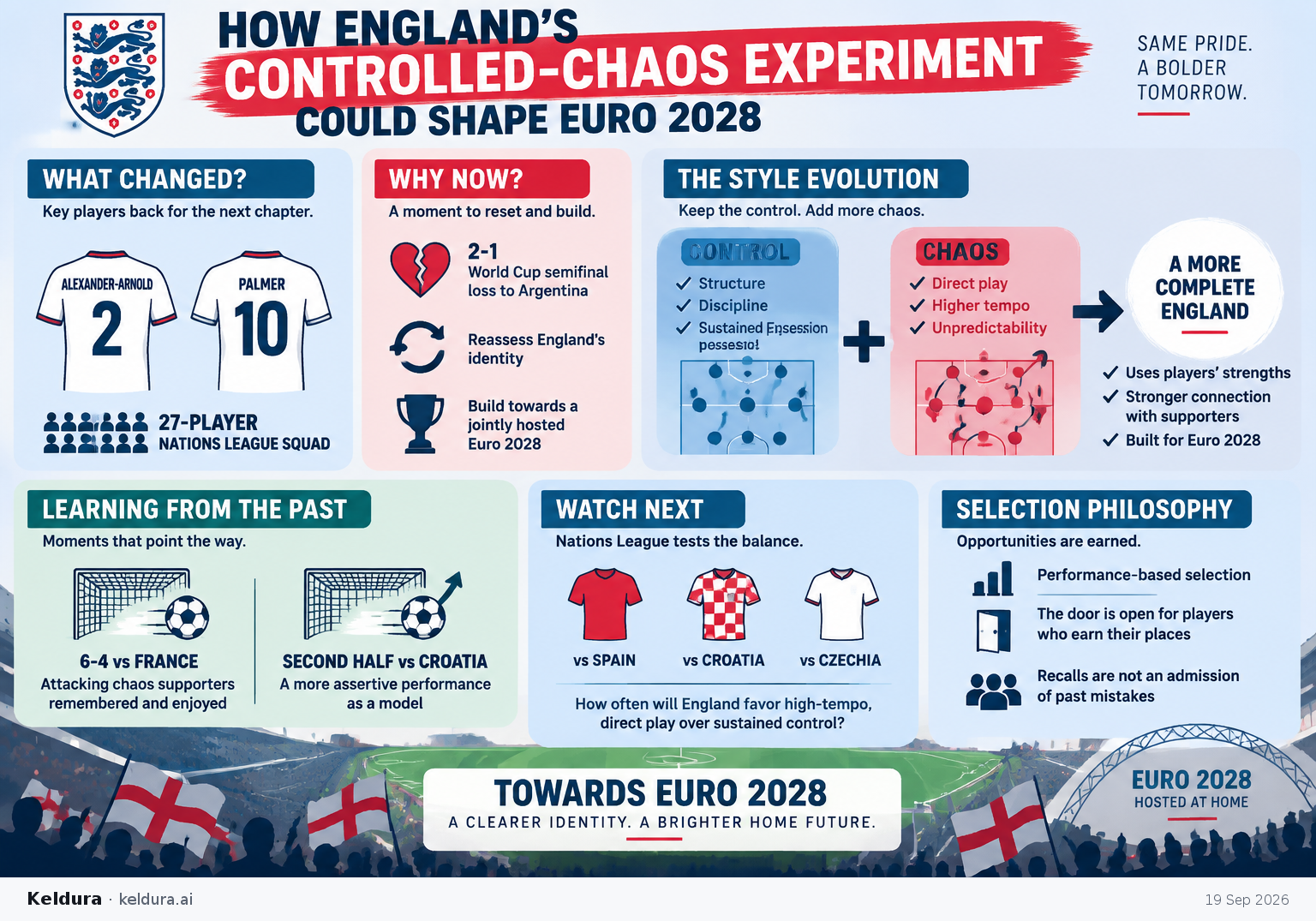
Tuchel named Palmer and Alexander-Arnold in a 27-player Nations League squad but said recalled players still have to perform.[6][8] After England’s 2-1 World Cup semifinal defeat by Argentina, he is considering a style that retains control while more fully embracing the directness, tempo and unpredictability associated with the Premier League.[8]
Why it matters: England will jointly host Euro 2028, and Tuchel believes the team needs an identity that draws more value from its players’ strengths and strengthens its connection with supporters.[8] The immediate Nations League schedule against Spain, Croatia and Czechia provides competitive matches in which to observe that adjustment.[8]
Key insights: Tuchel contrasted his preference for control with the attacking disorder of England’s 6-4 match against France, which he said supporters remembered as a particularly enjoyable experience.[8] | Palmer and Alexander-Arnold’s recalls were not presented as an admission that Tuchel selected the wrong World Cup squad.[8] | Tuchel identified England’s second half against Croatia and its performance against France as models for a more assertive approach.[8] | The coach said selection remains performance-based and that the door is open to players who earn their places.[6]
Cheatsheet facts: What changed: Palmer and Alexander-Arnold returned in a 27-player Nations League squad as Tuchel opened the next selection cycle.[6][8] | Why now: England is reassessing its identity after a 2-1 World Cup semifinal loss to Argentina and beginning its build toward a jointly hosted Euro 2028.[8] | Watch next: England’s Nations League matches against Spain, Croatia and Czechia will show how often the team favors high-tempo, direct play over sustained control.[8]
X copy pack
Edition complete
You've reached the end of this edition.