How Buffalo designed a smaller stadium to keep its home-field edge
The Buffalo Bills opened the new Highmark Stadium with a 41-31 win over the Detroit Lions on Thursday night.
The $2.1 billion stadium holds just over 60,000 spectators, roughly 12,000 fewer than its predecessor, but steeper seating and a canopy are designed to place fans closer to the action and project crowd noise toward the field [6]. More than 60,000 fans watched Josh Allen account for five touchdowns…
The $2.1 billion stadium holds just over 60,000 spectators, roughly 12,000 fewer than its predecessor, but steeper seating and a canopy are designed to place fans closer to the action and project crowd noise toward the field [6]. More than 60,000 fans watched Josh Allen account for five touchdowns as Buffalo produced the highest point total in a team’s home-stadium debut since Miami scored 42 in 1987 [1].
Why it matters: The opening offered an early test of whether a modern, lower-capacity venue can add premium amenities without weakening one of the NFL’s strongest home-field environments; the sustained noise suggested the vertical layout and canopy can help compensate for fewer seats [1][6].
Key insights: Buffalo reached a 21-0 lead and finished with a 41-31 victory, making Joe Brady the first coach in franchise history to win his first two games [1]. | The stadium’s seating bowl is more vertical than the old facility’s, while its canopy helps direct crowd noise onto the field [6]. | The Bills replaced the entire grass surface ahead of schedule after the original turf showed wear and produced large divots during preseason activity [6]. | The replacement field felt firmer to players, although an official still had to tamp down a displaced patch of grass during the opening drive [6].
Cheatsheet facts: What changed: Buffalo moved into a $2.1 billion, 60,000-plus-seat stadium with steeper seating and a noise-projecting canopy [1][6]. | Why now: The first regular-season game provided a live test of the venue after the Bills replaced its worn grass surface ahead of schedule [6]. | Watch next: Monitor the playing surface for further displaced turf and the stadium’s crowd-noise effect in future home games [1][6].
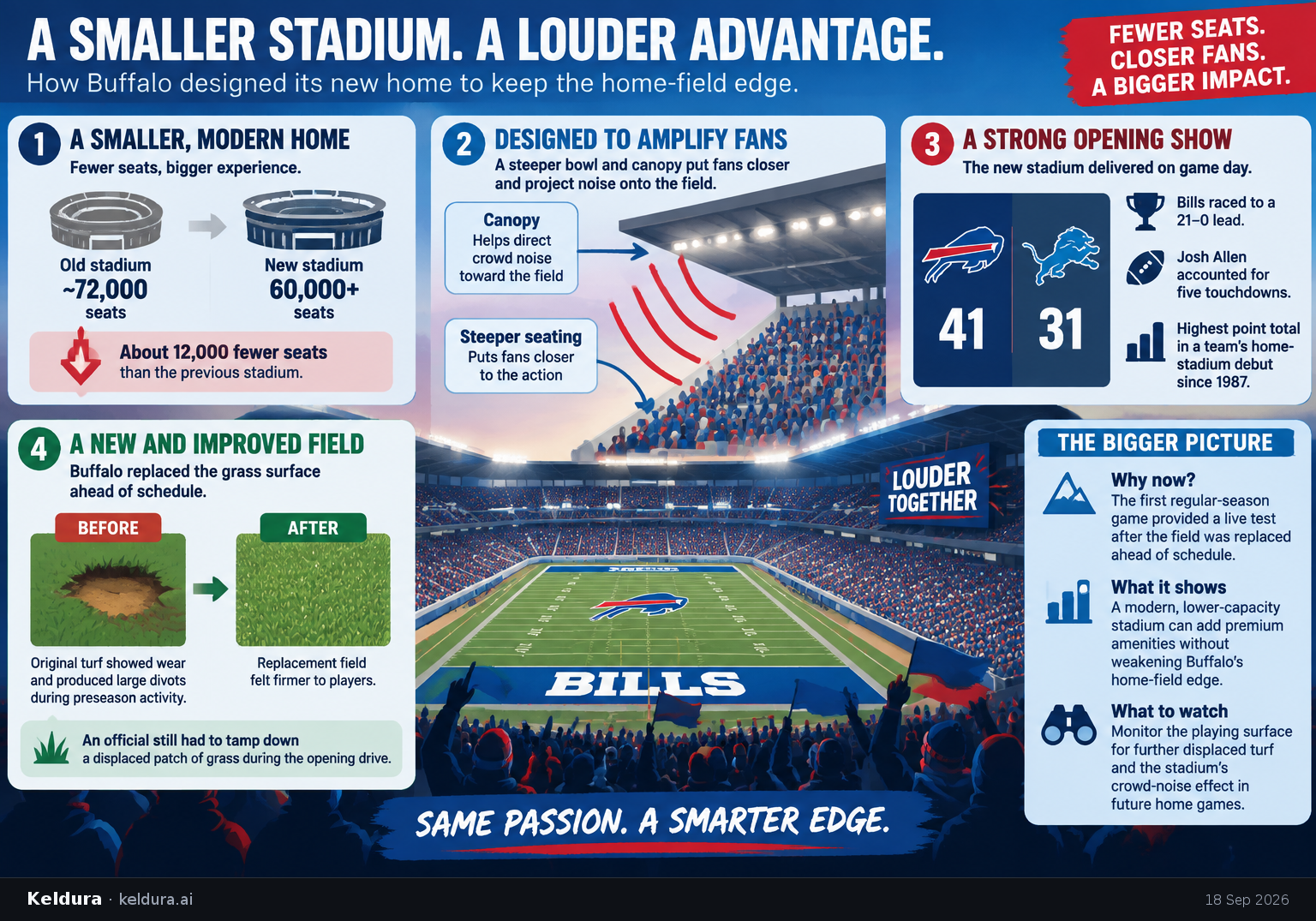
The $2.1 billion stadium holds just over 60,000 spectators, roughly 12,000 fewer than its predecessor, but steeper seating and a canopy are designed to place fans closer to the action and project crowd noise toward the field [6]. More than 60,000 fans watched Josh Allen account for five touchdowns as Buffalo produced the highest point total in a team’s home-stadium debut since Miami scored 42 in 1987 [1].
Why it matters: The opening offered an early test of whether a modern, lower-capacity venue can add premium amenities without weakening one of the NFL’s strongest home-field environments; the sustained noise suggested the vertical layout and canopy can help compensate for fewer seats [1][6].
Key insights: Buffalo reached a 21-0 lead and finished with a 41-31 victory, making Joe Brady the first coach in franchise history to win his first two games [1]. | The stadium’s seating bowl is more vertical than the old facility’s, while its canopy helps direct crowd noise onto the field [6]. | The Bills replaced the entire grass surface ahead of schedule after the original turf showed wear and produced large divots during preseason activity [6]. | The replacement field felt firmer to players, although an official still had to tamp down a displaced patch of grass during the opening drive [6].
Cheatsheet facts: What changed: Buffalo moved into a $2.1 billion, 60,000-plus-seat stadium with steeper seating and a noise-projecting canopy [1][6]. | Why now: The first regular-season game provided a live test of the venue after the Bills replaced its worn grass surface ahead of schedule [6]. | Watch next: Monitor the playing surface for further displaced turf and the stadium’s crowd-noise effect in future home games [1][6].
X copy pack
Edition complete
You've reached the end of this edition.