How does a disposable cargo ship sustain the space station?
Progress 96 docked with the International Space Station on September 19 after a three-day orbital pursuit.
The uncrewed Roscosmos spacecraft docked with the space-facing port of the station’s Poisk module at 9:44 a.m. EDT, carrying about three tons of food, fuel and supplies for Expedition 75 [6]. It launched aboard a Soyuz rocket from Baikonur Cosmodrome on September 16 and is scheduled to remain attac…
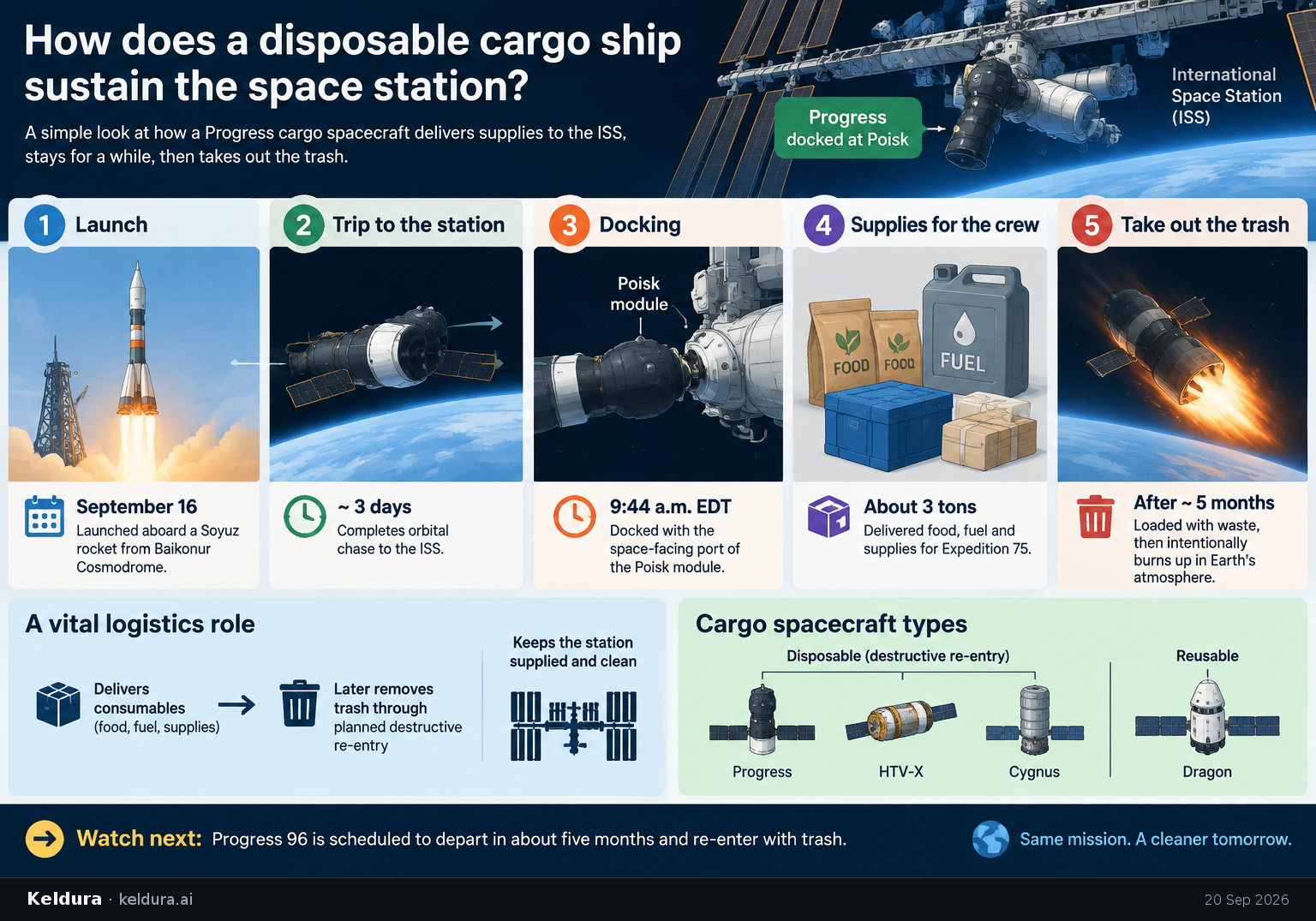
The uncrewed Roscosmos spacecraft docked with the space-facing port of the station’s Poisk module at 9:44 a.m. EDT, carrying about three tons of food, fuel and supplies for Expedition 75 [6]. It launched aboard a Soyuz rocket from Baikonur Cosmodrome on September 16 and is scheduled to remain attached for about five months [6].
Why it matters: Progress vehicles serve two functions in the station’s logistics chain: they deliver consumables and later remove trash through planned destructive atmospheric re-entry, unlike SpaceX’s reusable Dragon cargo capsule [6][7].
Key insights: The spacecraft’s trip from launch to docking lasted about three days [6][7]. | Progress 96 will be loaded with waste before it departs the station and burns up in Earth’s atmosphere [6][7]. | Progress, HTV-X and Cygnus cargo vehicles are designed for destructive disposal, while Dragon is the current cargo fleet’s reusable freighter [7].
Cheatsheet facts: What changed: Progress 96 delivered about three tons of food, fuel and supplies to Expedition 75 [6]. | Why now: The freighter completed the orbital chase begun with its September 16 Soyuz launch from Baikonur [6][7]. | Watch next: Watch for Progress 96’s departure in about five months and its planned trash-loaded destructive re-entry [6][7].
The uncrewed Roscosmos spacecraft docked with the space-facing port of the station’s Poisk module at 9:44 a.m. EDT, carrying about three tons of food, fuel and supplies for Expedition 75 [6]. It launched aboard a Soyuz rocket from Baikonur Cosmodrome on September 16 and is scheduled to remain attached for about five months [6].
Why it matters: Progress vehicles serve two functions in the station’s logistics chain: they deliver consumables and later remove trash through planned destructive atmospheric re-entry, unlike SpaceX’s reusable Dragon cargo capsule [6][7].
Key insights: The spacecraft’s trip from launch to docking lasted about three days [6][7]. | Progress 96 will be loaded with waste before it departs the station and burns up in Earth’s atmosphere [6][7]. | Progress, HTV-X and Cygnus cargo vehicles are designed for destructive disposal, while Dragon is the current cargo fleet’s reusable freighter [7].
Cheatsheet facts: What changed: Progress 96 delivered about three tons of food, fuel and supplies to Expedition 75 [6]. | Why now: The freighter completed the orbital chase begun with its September 16 Soyuz launch from Baikonur [6][7]. | Watch next: Watch for Progress 96’s departure in about five months and its planned trash-loaded destructive re-entry [6][7].
X copy pack
Edition complete
You've reached the end of this edition.