Nancy Grace Roman Space Telescope launches toward L2
NASA’s Nancy Grace Roman Space Telescope launched aboard a SpaceX Falcon Heavy from Kennedy Space Center at 7:26 a.m. EDT on August 30. [1][2] The observatory is now making a three-month, roughly one-million-mile journey to the second Sun-Earth Lagrange point, where it will undergo commissioning be…
NASA’s Nancy Grace Roman Space Telescope launched aboard a SpaceX Falcon Heavy from Kennedy Space Center at 7:26 a.m. EDT on August 30. [1][2] The observatory is now making a three-month, roughly one-million-mile journey to the second Sun-Earth Lagrange point, where it will undergo commissioning before beginning science operations. [1][3] Its wide-field infrared surveys will examine dark matter, dark energy and exoplanets while creating a broad new atlas of the universe. [1][4]
Why it matters: Roman combines a field of view 100 times larger than Hubble’s with survey speeds up to 1,000 times faster, enabling large-scale studies that complement the narrower views of Hubble and the James Webb Space Telescope. [3][4] Its 3D maps, gravitational-lensing measurements and exoplanet observations could substantially expand evidence about the universe’s unseen components and the diversity of planetary systems. [3][4]
Key insights: Roman’s 300-megapixel Wide Field Instrument uses 18 4K detectors and is expected to activate several weeks into the voyage. [1] | The Coronagraph Instrument will demonstrate technology for directly imaging Jupiter-like exoplanets by suppressing the glare of their host stars. [1][2] | Roman is designed to return 1.4 terabytes of data per day, with machine learning, artificial intelligence and citizen scientists helping identify notable findings. [1] | The initial science mission is planned to last five years, and its main survey is expected to take at least a year. [2][4]
Cheatsheet facts: What changed: Roman successfully launched, and NASA confirmed deployment of its solar panels and lower instrument sun shade. [1][5] | Why now: The launch begins a three-month transit and commissioning period involving additional deployments, instrument activation, calibration and two mid-course corrections. [1] | Watch next: Near-term indicators are deployment of the high-gain antenna and aperture cover, activation of the Coronagraph and Wide Field Instrument, and NASA’s planned release of the first images by early 2027. [1][5]
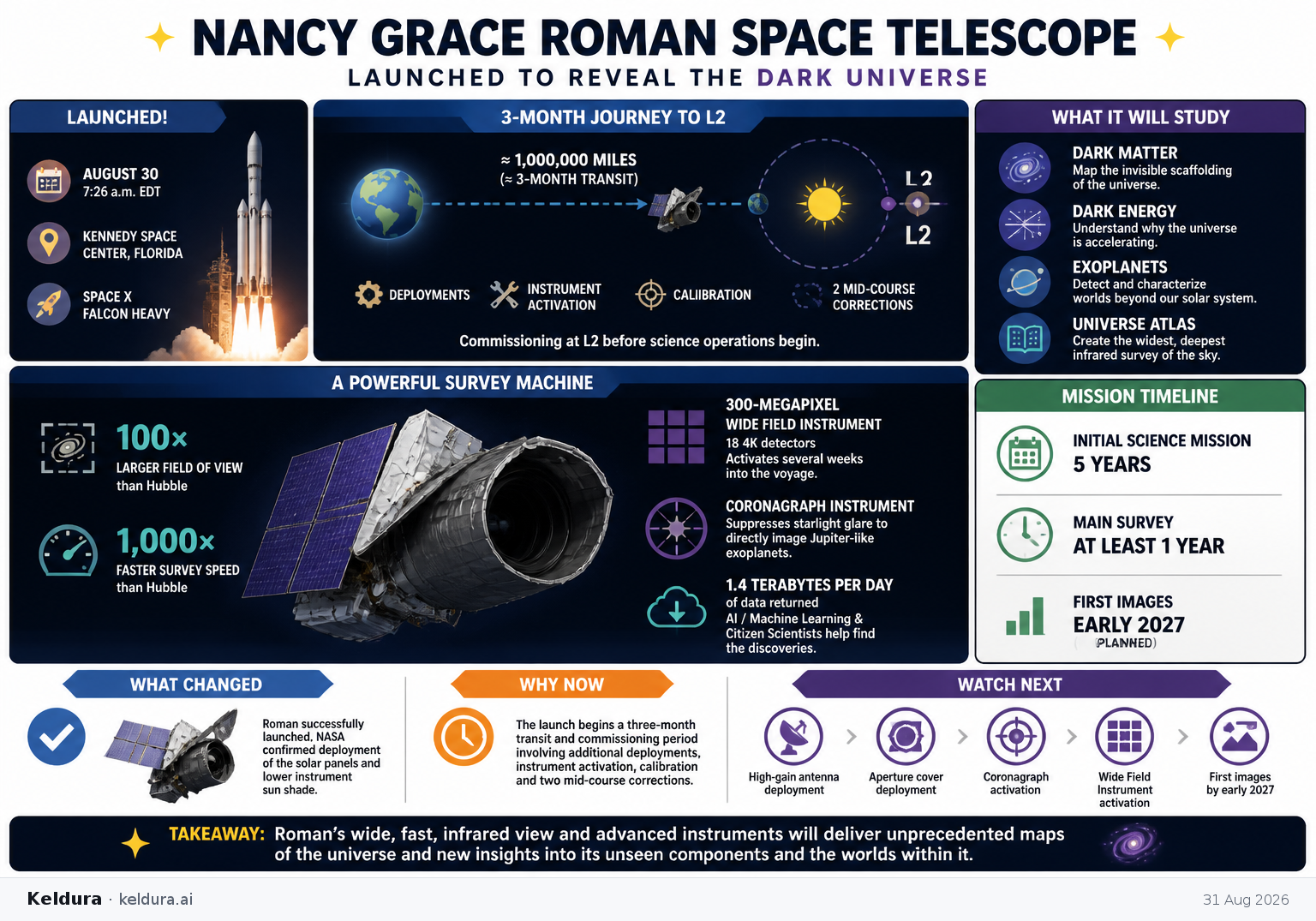
NASA’s Nancy Grace Roman Space Telescope launched aboard a SpaceX Falcon Heavy from Kennedy Space Center at 7:26 a.m. EDT on August 30. [1][2] The observatory is now making a three-month, roughly one-million-mile journey to the second Sun-Earth Lagrange point, where it will undergo commissioning before beginning science operations. [1][3] Its wide-field infrared surveys will examine dark matter, dark energy and exoplanets while creating a broad new atlas of the universe. [1][4]
Why it matters: Roman combines a field of view 100 times larger than Hubble’s with survey speeds up to 1,000 times faster, enabling large-scale studies that complement the narrower views of Hubble and the James Webb Space Telescope. [3][4] Its 3D maps, gravitational-lensing measurements and exoplanet observations could substantially expand evidence about the universe’s unseen components and the diversity of planetary systems. [3][4]
Key insights: Roman’s 300-megapixel Wide Field Instrument uses 18 4K detectors and is expected to activate several weeks into the voyage. [1] | The Coronagraph Instrument will demonstrate technology for directly imaging Jupiter-like exoplanets by suppressing the glare of their host stars. [1][2] | Roman is designed to return 1.4 terabytes of data per day, with machine learning, artificial intelligence and citizen scientists helping identify notable findings. [1] | The initial science mission is planned to last five years, and its main survey is expected to take at least a year. [2][4]
Cheatsheet facts: What changed: Roman successfully launched, and NASA confirmed deployment of its solar panels and lower instrument sun shade. [1][5] | Why now: The launch begins a three-month transit and commissioning period involving additional deployments, instrument activation, calibration and two mid-course corrections. [1] | Watch next: Near-term indicators are deployment of the high-gain antenna and aperture cover, activation of the Coronagraph and Wide Field Instrument, and NASA’s planned release of the first images by early 2027. [1][5]
X copy pack
Edition complete
You've reached the end of this edition.
[1] NASA’s Dark Universe-Seeking Nancy Grace Roman Space Telescope Launches - NASA — NASA News[2] NASA’s Nancy Grace Roman Telescope launches to space | Scientific American — scientificamerican.com[3] The Nancy Grace Roman Space Telescope launches to study dark matter and dark energy | The Verge — theverge.com[4] NASA set to launch Roman telescope to map the universe - France 24 — france24.com[5] NASA's Nancy Grace Roman Space Telescope Is Now On Its Way To Study The 'Dark Universe' — engadget.comPost to X