China’s updated moon map advances its bid to set space standards
The Institute of Geology, Chinese Academy of Geological Sciences unveiled an updated 1:5 million-scale lunar map on Aug. 6, revising boundaries for the ancient Aitkenian, Nectarian and Imbrian periods.[2] The map also introduces a proprietary cartographic standard that China says it plans to extend…
The Institute of Geology, Chinese Academy of Geological Sciences unveiled an updated 1:5 million-scale lunar map on Aug. 6, revising boundaries for the ancient Aitkenian, Nectarian and Imbrian periods.[2] The map also introduces a proprietary cartographic standard that China says it plans to extend to future planetary geologic mapping.[2]
Why it matters: The initiative shows that competition in lunar and deep-space exploration extends beyond missions to control over technical conventions, intellectual-property frameworks and standards adopted for mapping and other operations.[2]
Key insights: The new map updates a 2024 edition using newer scientific findings and recalibrated divisions of ancient lunar geologic eras.[2] | Its mapping system includes a standardized color scheme, geologic logic and a “lighter for younger, darker for older” visual principle.[2] | China intends to apply the standard beyond the moon as its exploration expands toward the outer solar system.[2] | China and the United States are also pursuing differing approaches to lunar timekeeping, illustrating the broader contest over whose space standards gain acceptance.[2]
Cheatsheet facts: What changed: Chinese researchers released a revised global lunar map with new geologic boundaries and a proprietary cartographic standard.[2] | Why now: Renewed lunar exploration has made technical standards—including mapping and lunar timekeeping—another arena of competition between China and the United States.[2] | Watch next: Observe whether China applies the map’s color scheme, geologic logic and age-based shading standard to maps produced for future planetary missions.[2]
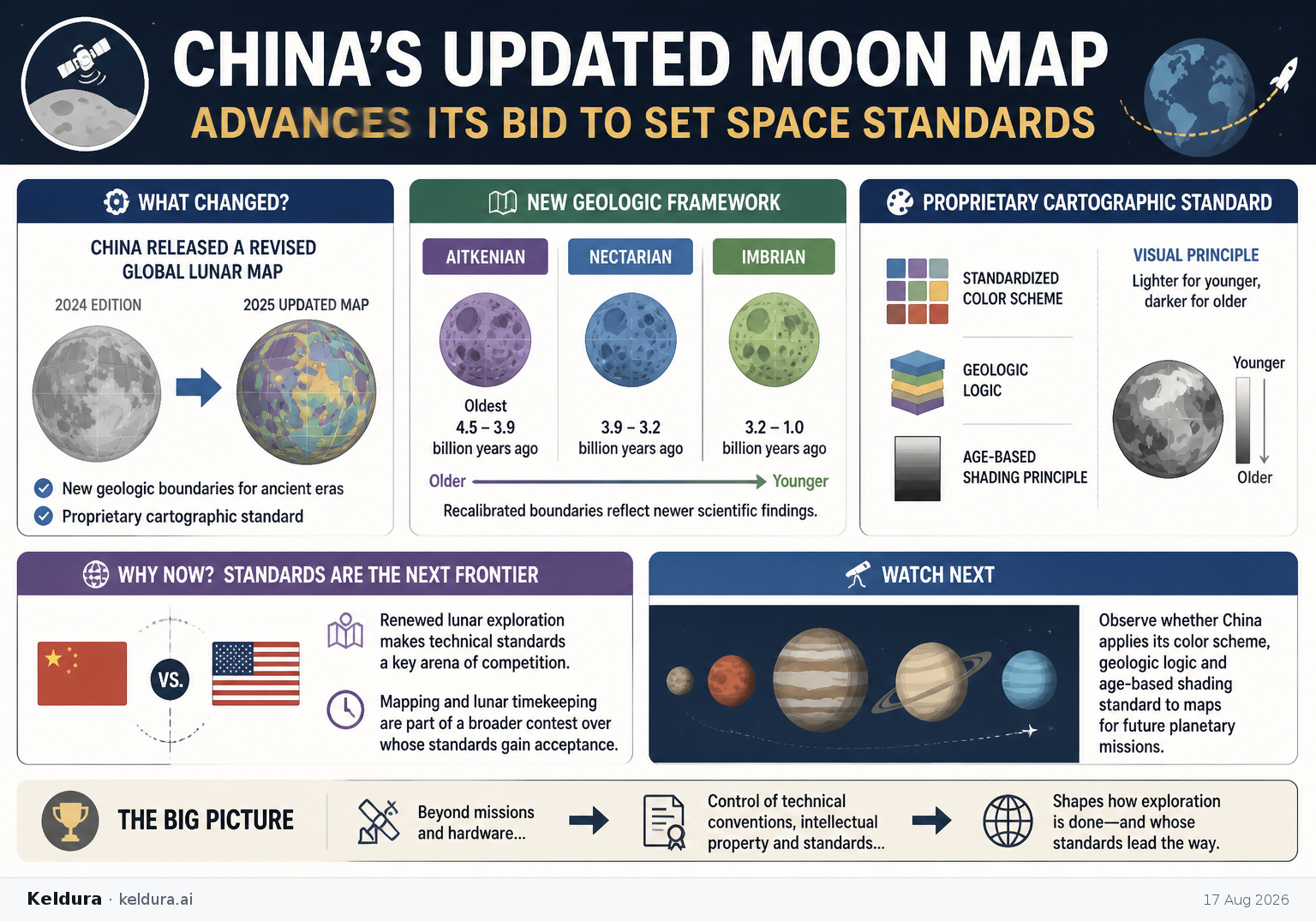
The Institute of Geology, Chinese Academy of Geological Sciences unveiled an updated 1:5 million-scale lunar map on Aug. 6, revising boundaries for the ancient Aitkenian, Nectarian and Imbrian periods.[2] The map also introduces a proprietary cartographic standard that China says it plans to extend to future planetary geologic mapping.[2]
Why it matters: The initiative shows that competition in lunar and deep-space exploration extends beyond missions to control over technical conventions, intellectual-property frameworks and standards adopted for mapping and other operations.[2]
Key insights: The new map updates a 2024 edition using newer scientific findings and recalibrated divisions of ancient lunar geologic eras.[2] | Its mapping system includes a standardized color scheme, geologic logic and a “lighter for younger, darker for older” visual principle.[2] | China intends to apply the standard beyond the moon as its exploration expands toward the outer solar system.[2] | China and the United States are also pursuing differing approaches to lunar timekeeping, illustrating the broader contest over whose space standards gain acceptance.[2]
Cheatsheet facts: What changed: Chinese researchers released a revised global lunar map with new geologic boundaries and a proprietary cartographic standard.[2] | Why now: Renewed lunar exploration has made technical standards—including mapping and lunar timekeeping—another arena of competition between China and the United States.[2] | Watch next: Observe whether China applies the map’s color scheme, geologic logic and age-based shading standard to maps produced for future planetary missions.[2]
X copy pack
Edition complete
You've reached the end of this edition.