How an eclipse becomes a multi-layered laboratory
The eclipse over parts of Europe will briefly reveal the normally hidden solar corona, but natural totality lasts only a few minutes.
The eclipse over parts of Europe will briefly reveal the normally hidden solar corona, but natural totality lasts only a few minutes.[5] NASA’s WB-57 jet will chase the Moon’s shadow with four cameras, while NASA-supported balloon teams will measure atmospheric changes as daylight abruptly dims.[8]
The eclipse over parts of Europe will briefly reveal the normally hidden solar corona, but natural totality lasts only a few minutes.[5] NASA’s WB-57 jet will chase the Moon’s shadow with four cameras, while NASA-supported balloon teams will measure atmospheric changes as daylight abruptly dims.[8]
Why it matters: The combined campaign can connect coronal structures and outflows with the solar wind while examining how sudden darkness changes ozone and Earth’s temperature- and moisture-sensitive atmospheric boundary layer.[8]
Key insights: Aircraft can lengthen the useful observing window by moving with the Moon’s shadow rather than remaining at one ground location.[8] | Four cameras inside the WB-57’s nose cone will image the corona’s structures, outflows and changes.[8] | Balloon measurements target ozone and the atmospheric boundary layer, turning the eclipse into an Earth-science experiment as well as a solar one.[8] | ESA also uses artificial-eclipse missions and computer simulations because natural total eclipses are rare and brief.[5]
Cheatsheet facts: What changed: NASA is combining a shadow-chasing WB-57 jet with balloon observations for the Aug. 12 eclipse.[8] | Why now: Totality briefly exposes the corona, creating a rare observing opportunity that lasts at most a few minutes from any natural eclipse vantage point.[5] | Watch next: Watch for the jet’s coronal imagery and balloon measurements of ozone and boundary-layer changes collected during the eclipse.[8]
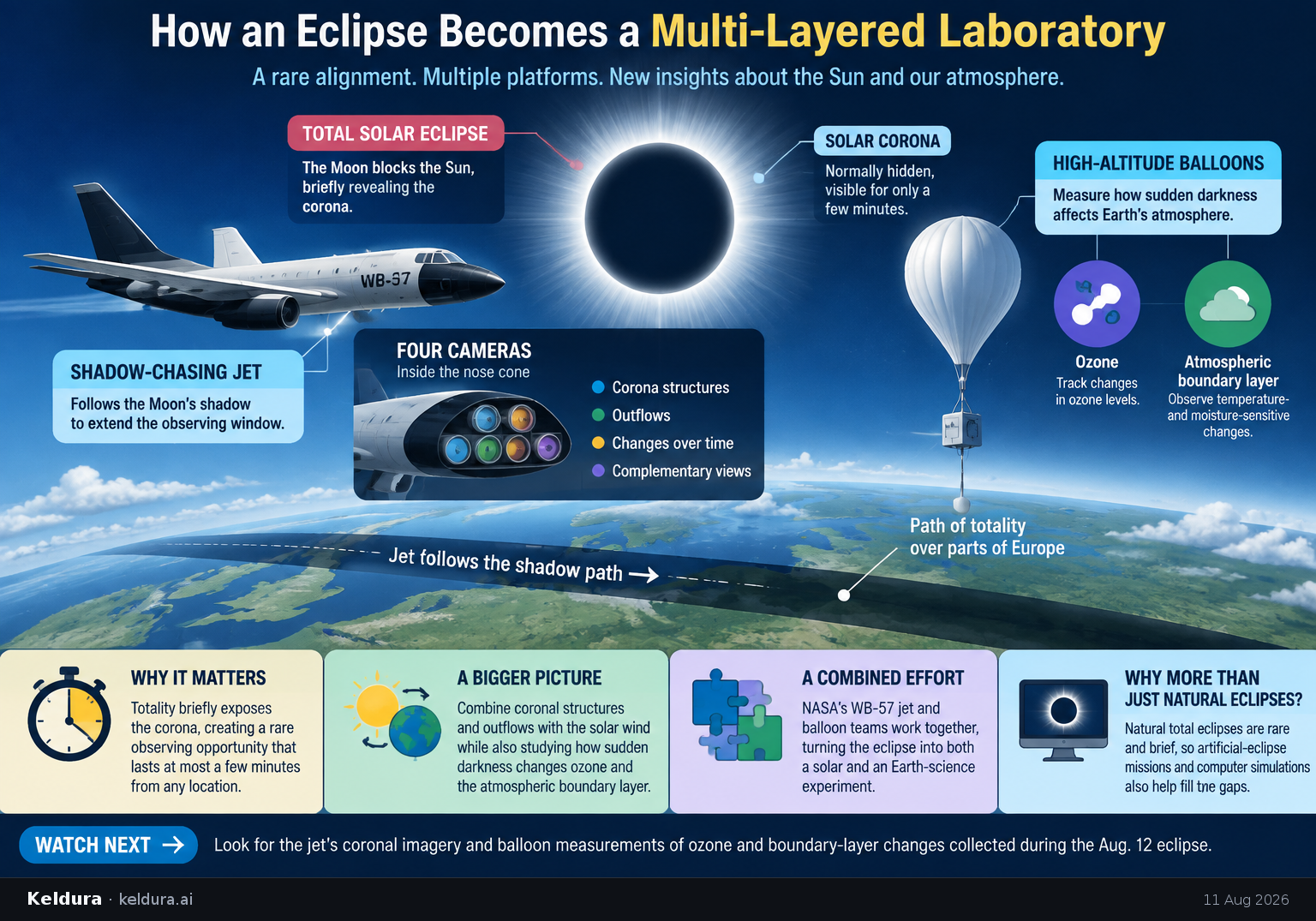
The eclipse over parts of Europe will briefly reveal the normally hidden solar corona, but natural totality lasts only a few minutes.[5] NASA’s WB-57 jet will chase the Moon’s shadow with four cameras, while NASA-supported balloon teams will measure atmospheric changes as daylight abruptly dims.[8]
Why it matters: The combined campaign can connect coronal structures and outflows with the solar wind while examining how sudden darkness changes ozone and Earth’s temperature- and moisture-sensitive atmospheric boundary layer.[8]
Key insights: Aircraft can lengthen the useful observing window by moving with the Moon’s shadow rather than remaining at one ground location.[8] | Four cameras inside the WB-57’s nose cone will image the corona’s structures, outflows and changes.[8] | Balloon measurements target ozone and the atmospheric boundary layer, turning the eclipse into an Earth-science experiment as well as a solar one.[8] | ESA also uses artificial-eclipse missions and computer simulations because natural total eclipses are rare and brief.[5]
Cheatsheet facts: What changed: NASA is combining a shadow-chasing WB-57 jet with balloon observations for the Aug. 12 eclipse.[8] | Why now: Totality briefly exposes the corona, creating a rare observing opportunity that lasts at most a few minutes from any natural eclipse vantage point.[5] | Watch next: Watch for the jet’s coronal imagery and balloon measurements of ozone and boundary-layer changes collected during the eclipse.[8]
X copy pack
Edition complete
You've reached the end of this edition.