NASA Webb study argues some little red dots may be a temporary phase of active black holes
NASA scientists reported a new interpretation of little red dots, based on the spiral galaxy WISEA J123635.56+621424.2, nicknamed the “Saguaro” [5][6][7]. The team used Hubble and Webb data, plus synthetic redshifting, to argue that these compact red sources may be a temporary phase of highly activ…
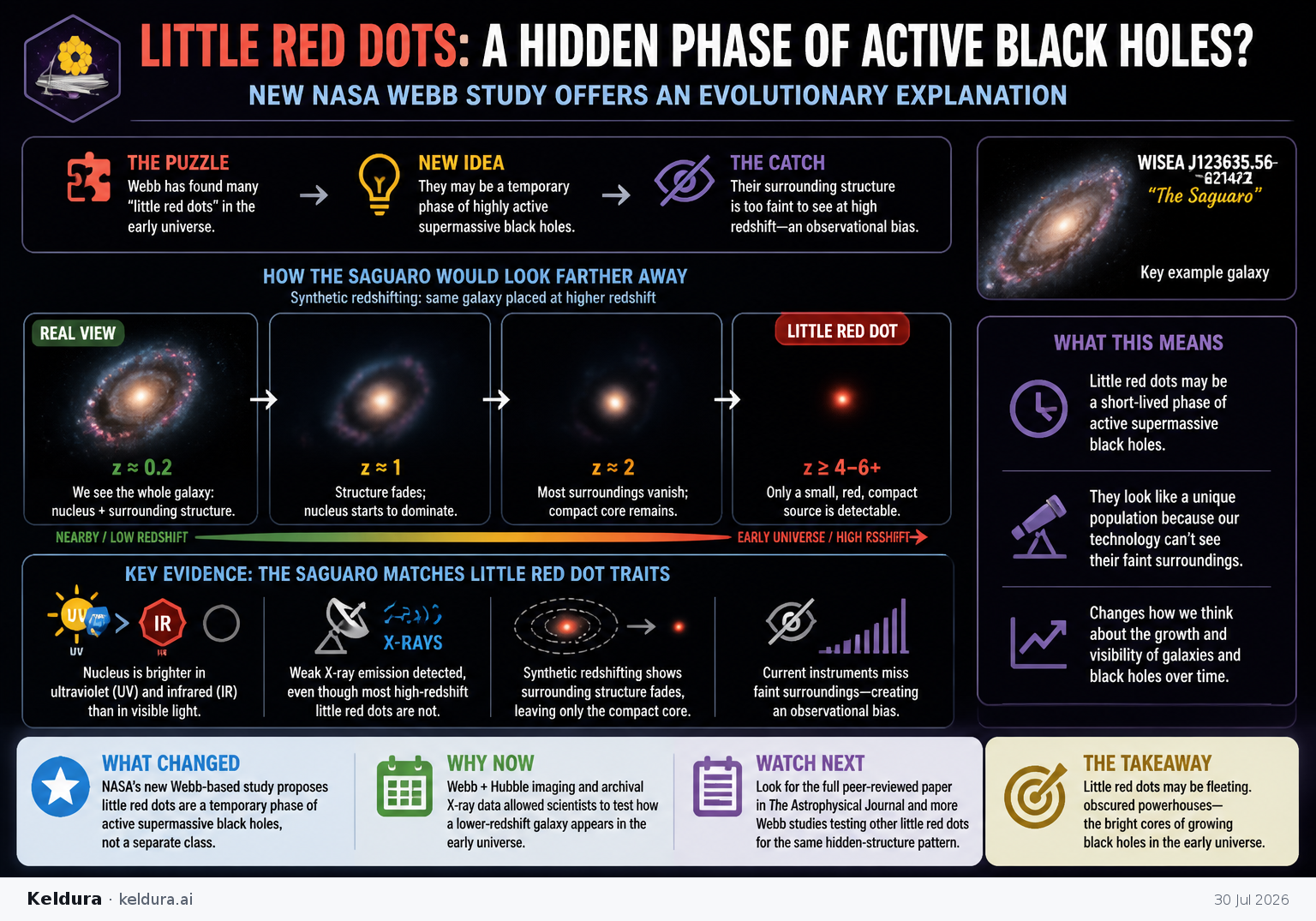
NASA scientists reported a new interpretation of little red dots, based on the spiral galaxy WISEA J123635.56+621424.2, nicknamed the “Saguaro” [5][6][7]. The team used Hubble and Webb data, plus synthetic redshifting, to argue that these compact red sources may be a temporary phase of highly active supermassive black holes and that observational bias may hide their surrounding structure at high redshift [5][6][7].
Why it matters: This matters because little red dots have been a major Webb-era puzzle, and the new work offers a concrete evolutionary pathway for objects seen in the early universe [5][7]. If the interpretation holds, it changes how astronomers think about the growth and visibility of compact galaxies and black-hole systems over cosmic time [5][7].
Key insights: The study says the Saguaro’s nucleus is brighter in ultraviolet and infrared light than in visible light, matching key little red dot traits [5][6]. | The team also found weak X-ray emission from the Saguaro, even though most high-redshift little red dots are not detectable in X-ray light [5]. | By synthetically shifting the galaxy to higher redshift, the researchers showed that the surrounding structure fades and only the central compact source remains visible [5][6]. | NASA says the result suggests little red dots may look like a unique population partly because current technology cannot sample their faint surroundings well enough [5].
Cheatsheet facts: What changed: NASA released a Webb-based study proposing that little red dots may be a short-lived phase of active supermassive black holes rather than a wholly separate class [5][6][7]. | Why now: Webb, Hubble and archival X-ray data made it possible to test how a lower-redshift galaxy would appear if observed in the early universe [5][6][7]. | Watch next: Look for the full peer-reviewed discussion in The Astrophysical Journal and any additional Webb studies testing whether other little red dots show the same hidden-structure pattern [5].
NASA scientists reported a new interpretation of little red dots, based on the spiral galaxy WISEA J123635.56+621424.2, nicknamed the “Saguaro” [5][6][7]. The team used Hubble and Webb data, plus synthetic redshifting, to argue that these compact red sources may be a temporary phase of highly active supermassive black holes and that observational bias may hide their surrounding structure at high redshift [5][6][7].
Why it matters: This matters because little red dots have been a major Webb-era puzzle, and the new work offers a concrete evolutionary pathway for objects seen in the early universe [5][7]. If the interpretation holds, it changes how astronomers think about the growth and visibility of compact galaxies and black-hole systems over cosmic time [5][7].
Key insights: The study says the Saguaro’s nucleus is brighter in ultraviolet and infrared light than in visible light, matching key little red dot traits [5][6]. | The team also found weak X-ray emission from the Saguaro, even though most high-redshift little red dots are not detectable in X-ray light [5]. | By synthetically shifting the galaxy to higher redshift, the researchers showed that the surrounding structure fades and only the central compact source remains visible [5][6]. | NASA says the result suggests little red dots may look like a unique population partly because current technology cannot sample their faint surroundings well enough [5].
Cheatsheet facts: What changed: NASA released a Webb-based study proposing that little red dots may be a short-lived phase of active supermassive black holes rather than a wholly separate class [5][6][7]. | Why now: Webb, Hubble and archival X-ray data made it possible to test how a lower-redshift galaxy would appear if observed in the early universe [5][6][7]. | Watch next: Look for the full peer-reviewed discussion in The Astrophysical Journal and any additional Webb studies testing whether other little red dots show the same hidden-structure pattern [5].
X copy pack
Edition complete
You've reached the end of this edition.