NASA’s Swift boosting spacecraft is halfway through commissioning after launch
Katalyst Space’s LINK spacecraft launched on July 3 and is now about halfway through commissioning as NASA prepares a mission to raise the altitude of the Neil Gehrels Swift Observatory [2]. NASA says the spacecraft completed initial postlaunch steps, deployed its solar array, established communica…
Katalyst Space’s LINK spacecraft launched on July 3 and is now about halfway through commissioning as NASA prepares a mission to raise the altitude of the Neil Gehrels Swift Observatory [2]. NASA says the spacecraft completed initial postlaunch steps, deployed its solar array, established communications, and carried out power, avionics, and propulsion checkouts, including thruster firings [2]. The team also addressed early communications and attitude-control issues with software patches and operational updates that restored reliable performance [2].
Why it matters: Swift is a NASA satellite that studies gamma-ray bursts and other cosmic events, so a successful boost mission would help extend the observatory’s science return [2]. The commissioning progress is important because LINK must remain healthy and complete transit and orbital-raise preparations before it can meet Swift and begin the altitude-boost effort [2].
Key insights: LINK’s solar array spans about 20 feet and is being used to power systems during commissioning [2]. | Katalyst says the spacecraft is healthy and has already commissioned its power systems and avionics [2]. | The mission will use xenon-fueled thrusters to travel to Swift and slowly raise its orbit over several months [2]. | NASA says the commissioning phase will continue over the coming weeks with built-in flexibility to pause, assess data, and adjust as needed [2].
Cheatsheet facts: What changed: LINK has moved from launch and initial checkouts into mid-commissioning, with solar arrays deployed and major spacecraft systems checked out [2]. | Why now: The spacecraft must be fully commissioned before it can begin transit to Swift and the orbital altitude boost [2]. | Watch next: Look for NASA’s next Swift blog updates on completion of commissioning and the start of LINK’s transit phase [2].
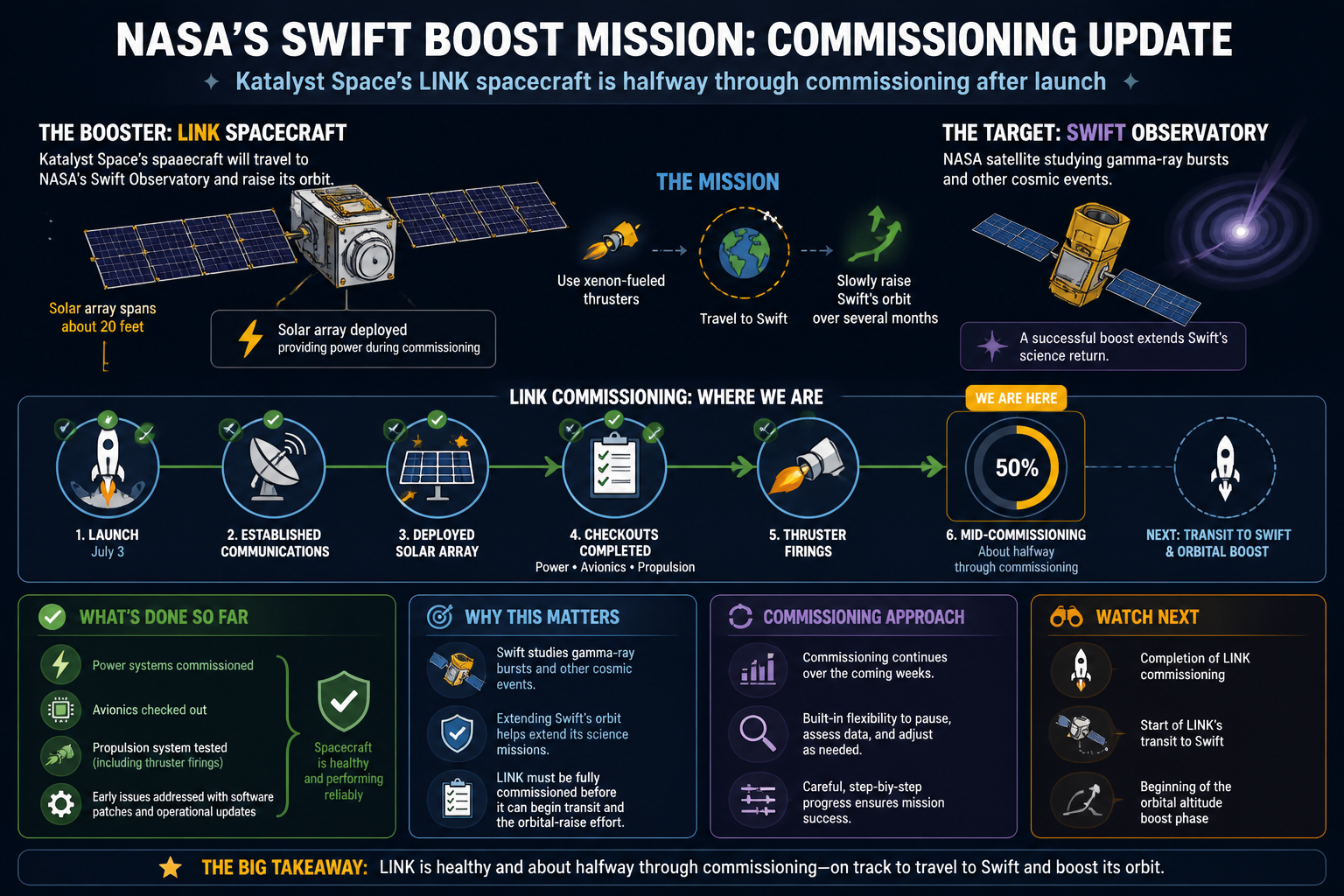
Katalyst Space’s LINK spacecraft launched on July 3 and is now about halfway through commissioning as NASA prepares a mission to raise the altitude of the Neil Gehrels Swift Observatory [2]. NASA says the spacecraft completed initial postlaunch steps, deployed its solar array, established communications, and carried out power, avionics, and propulsion checkouts, including thruster firings [2]. The team also addressed early communications and attitude-control issues with software patches and operational updates that restored reliable performance [2].
Why it matters: Swift is a NASA satellite that studies gamma-ray bursts and other cosmic events, so a successful boost mission would help extend the observatory’s science return [2]. The commissioning progress is important because LINK must remain healthy and complete transit and orbital-raise preparations before it can meet Swift and begin the altitude-boost effort [2].
Key insights: LINK’s solar array spans about 20 feet and is being used to power systems during commissioning [2]. | Katalyst says the spacecraft is healthy and has already commissioned its power systems and avionics [2]. | The mission will use xenon-fueled thrusters to travel to Swift and slowly raise its orbit over several months [2]. | NASA says the commissioning phase will continue over the coming weeks with built-in flexibility to pause, assess data, and adjust as needed [2].
Cheatsheet facts: What changed: LINK has moved from launch and initial checkouts into mid-commissioning, with solar arrays deployed and major spacecraft systems checked out [2]. | Why now: The spacecraft must be fully commissioned before it can begin transit to Swift and the orbital altitude boost [2]. | Watch next: Look for NASA’s next Swift blog updates on completion of commissioning and the start of LINK’s transit phase [2].
X copy pack
Edition complete
You've reached the end of this edition.