What Kenya’s imported Ebola case reveals about border screening
WHO reported on October 8 that a patient arriving in Kenya from the Democratic Republic of the Congo through Uganda died of Ebola.
WHO confirmed that the patient arrived in Nairobi on October 3 and died on October 5; Kenya and Uganda have initiated public health responses, including contact tracing. [5] The Democratic Republic of the Congo recorded 8,728 confirmed cases and 4,205 confirmed deaths as of October 6, with the outb…
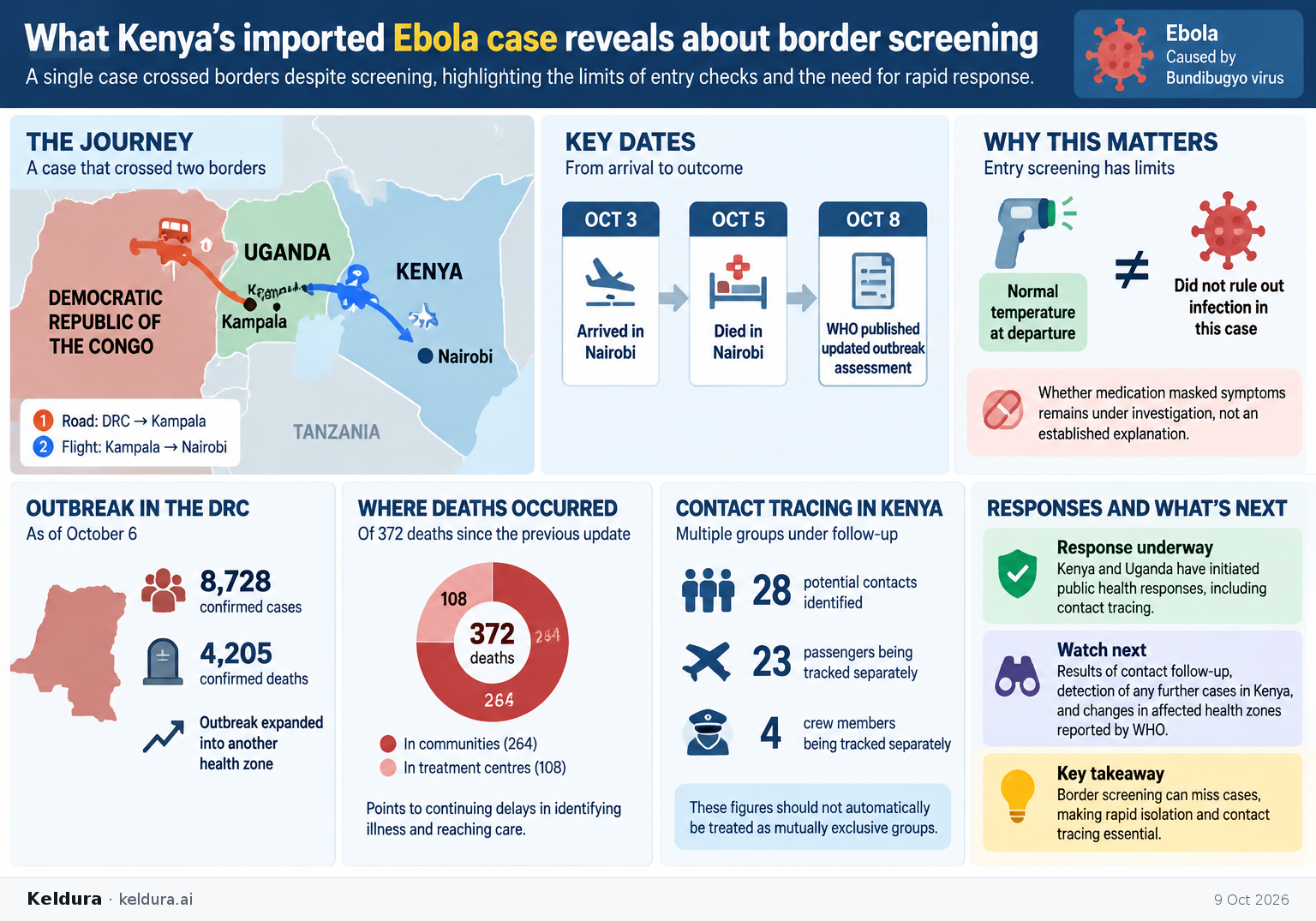
WHO confirmed that the patient arrived in Nairobi on October 3 and died on October 5; Kenya and Uganda have initiated public health responses, including contact tracing. [5] The Democratic Republic of the Congo recorded 8,728 confirmed cases and 4,205 confirmed deaths as of October 6, with the outbreak expanding into another health zone. [5]
Why it matters: The imported case exposes the limits of entry screening while underscoring the importance of rapid isolation and contact tracing: Uganda reported a normal temperature at departure, but WHO says the patient’s symptom status during travel remains unclear. [2][5]
Key insights: The travel sequence crossed two borders: a road journey from the Democratic Republic of the Congo to Kampala, followed by a flight to Nairobi. [5] | Kenyan authorities identified 28 potential contacts and were separately tracking 23 passengers and four crew members from the flight; those figures should not automatically be treated as mutually exclusive groups. [2] | A normal temperature at screening did not rule out infection in this case; suggestions that medication masked symptoms remain under investigation, not established explanations. [2] | Of 372 deaths reported since WHO’s previous update, 264 occurred in communities rather than treatment centres, pointing to continuing delays in identifying illness and reaching care. [5]
Cheatsheet facts: What changed: An imported fatal case triggered contact tracing in Kenya and Uganda as the outbreak’s footprint expanded in the Democratic Republic of the Congo. [5] | Why now: The patient arrived in Nairobi on October 3 and died on October 5; WHO published its updated outbreak assessment on October 8. [5] | Watch next: Results of contact follow-up, detection of any further cases in Kenya, and changes in the affected health zones reported by WHO. [2][5]