Papua New Guinea and the Philippines draft public-health workforce plans
Health workforce leaders and public-health professionals from Papua New Guinea and the Philippines joined WHO experts for a Training of Trainers Workshop on 8–10 June 2026.[2] Participants used WHO tools to identify priorities and technical-assistance needs, producing draft national implementation…
Health workforce leaders and public-health professionals from Papua New Guinea and the Philippines joined WHO experts for a Training of Trainers Workshop on 8–10 June 2026.[2] Participants used WHO tools to identify priorities and technical-assistance needs, producing draft national implementation plans for essential public health functions.[2]
Why it matters: WHO says these functions underpin disease prevention, surveillance, emergency preparedness, health promotion and governance, while delivery depends on coordinated workers across health, education, sanitation, environment, agriculture and One Health.[2]
Key insights: The training addressed competency-based education and methods for mapping and measuring the occupations and skills needed to deliver essential public health functions.[2] | Participants were prepared to adapt and cascade the training at national and subnational levels.[2] | The initiative responds to overlapping pressures including ageing populations, antimicrobial resistance, changing disease patterns and climate-related disasters.[2] | The Philippines workshop also connects to PhilPAC, which positions the country as a peer-learning hub for Pacific countries and areas facing workforce shortages, climate risks, service-continuity problems and geographic isolation.[2]
Cheatsheet facts: What changed: Country teams from Papua New Guinea and the Philippines completed draft implementation plans and received training to extend WHO workforce tools more widely.[2] | Why now: Countries need coordinated capacity across multiple sectors to sustain routine services and prepare for health emergencies amid demographic, disease and climate pressures.[2] | Watch next: Watch for the draft plans to be adapted nationally and for trainers to cascade the tools to national and subnational workforces.[2]
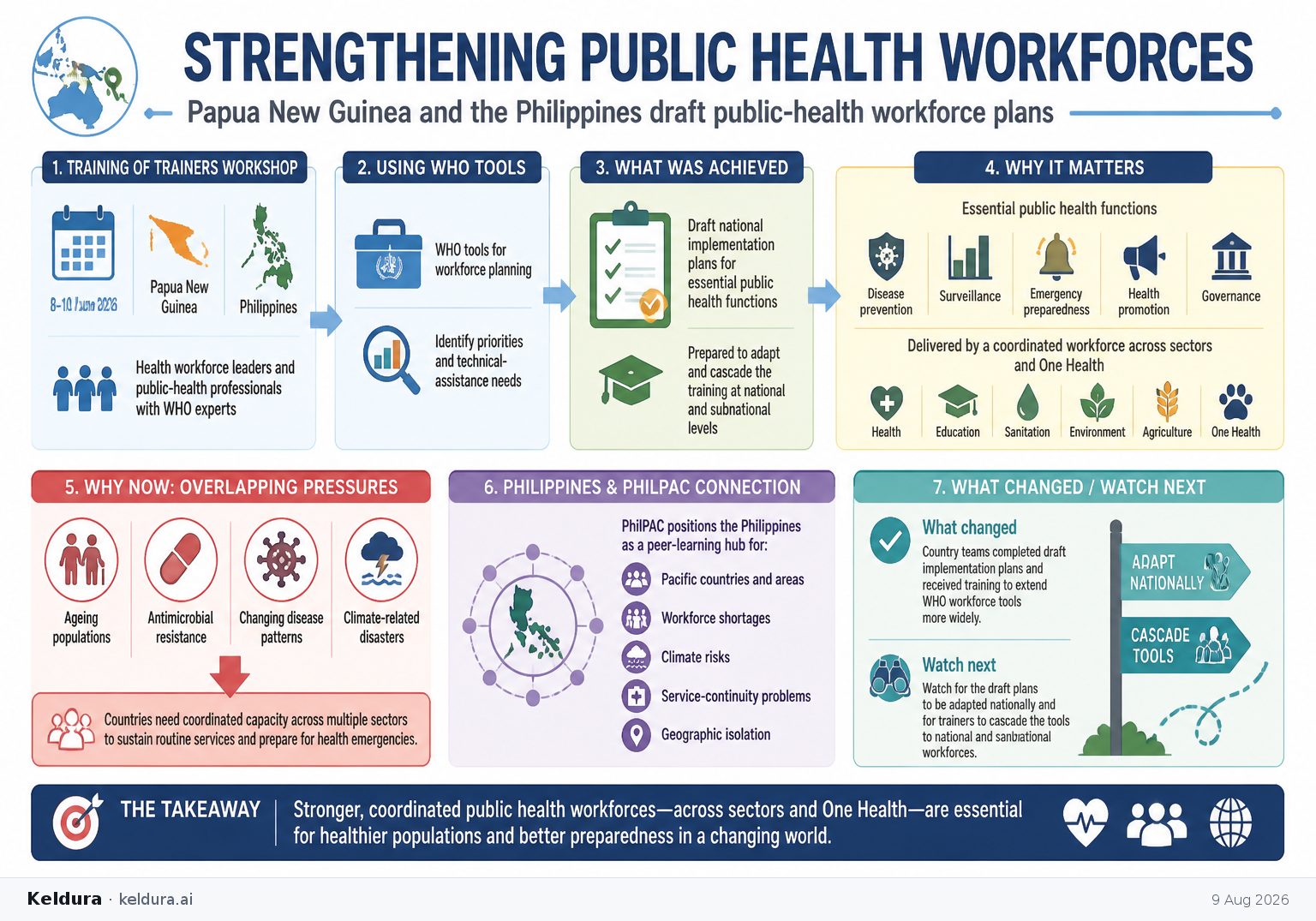
Health workforce leaders and public-health professionals from Papua New Guinea and the Philippines joined WHO experts for a Training of Trainers Workshop on 8–10 June 2026.[2] Participants used WHO tools to identify priorities and technical-assistance needs, producing draft national implementation plans for essential public health functions.[2]
Why it matters: WHO says these functions underpin disease prevention, surveillance, emergency preparedness, health promotion and governance, while delivery depends on coordinated workers across health, education, sanitation, environment, agriculture and One Health.[2]
Key insights: The training addressed competency-based education and methods for mapping and measuring the occupations and skills needed to deliver essential public health functions.[2] | Participants were prepared to adapt and cascade the training at national and subnational levels.[2] | The initiative responds to overlapping pressures including ageing populations, antimicrobial resistance, changing disease patterns and climate-related disasters.[2] | The Philippines workshop also connects to PhilPAC, which positions the country as a peer-learning hub for Pacific countries and areas facing workforce shortages, climate risks, service-continuity problems and geographic isolation.[2]
Cheatsheet facts: What changed: Country teams from Papua New Guinea and the Philippines completed draft implementation plans and received training to extend WHO workforce tools more widely.[2] | Why now: Countries need coordinated capacity across multiple sectors to sustain routine services and prepare for health emergencies amid demographic, disease and climate pressures.[2] | Watch next: Watch for the draft plans to be adapted nationally and for trainers to cascade the tools to national and subnational workforces.[2]
X copy pack
Edition complete
You've reached the end of this edition.