Why did India restart rate hikes despite stronger growth?
The RBI raised its repo rate Wednesday for the first time since February 2023, shifting India back toward tighter policy.
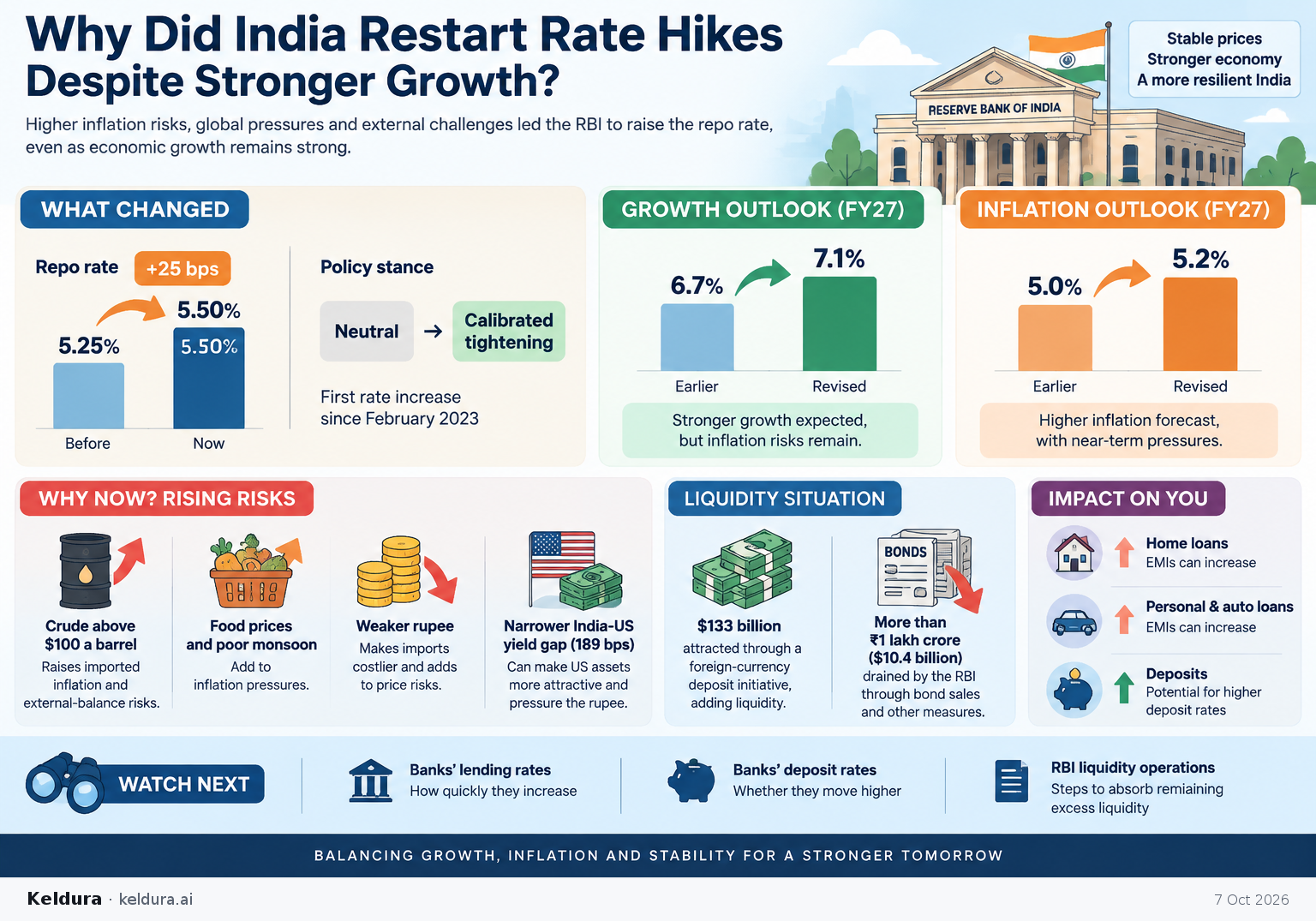
The Reserve Bank of India raised the repo rate by 25 basis points to 5.50%, its first increase since February 2023, and changed its stance from neutral to calibrated tightening.[5][6] It simultaneously lifted its FY27 growth projection from 6.7% to 7.1% and its inflation forecast from 5% to 5.2%.[6]
The Reserve Bank of India raised the repo rate by 25 basis points to 5.50%, its first increase since February 2023, and changed its stance from neutral to calibrated tightening.[5][6] It simultaneously lifted its FY27 growth projection from 6.7% to 7.1% and its inflation forecast from 5% to 5.2%.[6]
Why it matters: The increase can raise payments on benchmark-linked home, personal and vehicle loans, while potentially supporting deposit rates.[6] It also shows how an energy-importing economy can tighten policy even during strong growth when oil, food prices, currency weakness and global yields threaten inflation and capital flows.[5][6]
Key insights: Retail inflation reached 4.82% in August, exceeding the RBI’s 4% medium-term target for a third month while remaining inside its 2%-6% tolerance band.[6] | Crude above $100 a barrel raises imported-inflation and external-balance risks for India, which imports most of its energy.[5][6] | The India-US 10-year yield gap narrowed to 189 basis points, potentially making US assets more attractive and adding pressure on the rupee.[5] | About $133 billion attracted through a foreign-currency deposit initiative added banking-system liquidity; the RBI has already drained more than ₹1 lakh crore, or $10.4 billion, through bond sales and other measures.[5]
Cheatsheet facts: What changed: The repo rate rose 25 basis points to 5.50%, and the RBI shifted from a neutral stance to calibrated tightening.[5][6] | Why now: Oil above $100, a weaker rupee, poor monsoon conditions and rising inflation have increased price risks despite strong economic activity.[5][6] | Watch next: Monitor banks’ lending and deposit-rate changes, along with RBI operations to absorb remaining excess liquidity.[5][6]
The Reserve Bank of India raised the repo rate by 25 basis points to 5.50%, its first increase since February 2023, and changed its stance from neutral to calibrated tightening.[5][6] It simultaneously lifted its FY27 growth projection from 6.7% to 7.1% and its inflation forecast from 5% to 5.2%.[6]
Why it matters: The increase can raise payments on benchmark-linked home, personal and vehicle loans, while potentially supporting deposit rates.[6] It also shows how an energy-importing economy can tighten policy even during strong growth when oil, food prices, currency weakness and global yields threaten inflation and capital flows.[5][6]
Key insights: Retail inflation reached 4.82% in August, exceeding the RBI’s 4% medium-term target for a third month while remaining inside its 2%-6% tolerance band.[6] | Crude above $100 a barrel raises imported-inflation and external-balance risks for India, which imports most of its energy.[5][6] | The India-US 10-year yield gap narrowed to 189 basis points, potentially making US assets more attractive and adding pressure on the rupee.[5] | About $133 billion attracted through a foreign-currency deposit initiative added banking-system liquidity; the RBI has already drained more than ₹1 lakh crore, or $10.4 billion, through bond sales and other measures.[5]
Cheatsheet facts: What changed: The repo rate rose 25 basis points to 5.50%, and the RBI shifted from a neutral stance to calibrated tightening.[5][6] | Why now: Oil above $100, a weaker rupee, poor monsoon conditions and rising inflation have increased price risks despite strong economic activity.[5][6] | Watch next: Monitor banks’ lending and deposit-rate changes, along with RBI operations to absorb remaining excess liquidity.[5][6]
X copy pack
[5] RBI MPC Meeting 2026: Malhotra & Co hike repo rate by 25 bps to 5.50% for first time in nearly 4 years as inflation pressures build - The Economic Times — economictimes.indiatimes.com[6] RBI Hikes Repo Rate to 5.50% After 3.5 Years: How Your Home, Personal, and Auto Loan EMIs Will Be Impacted — indianexpress.comRead in BriefingsPost to X