Can China’s targeted support arrest its domestic slowdown?
On Sept. 28, China’s State Council promised additional counter-cyclical measures and further study of policies to stabilise housing.
China’s cabinet said it would introduce a package of additional policies, tap unused local-government bond capacity and consider measures supporting property, employment and household income.[3] The signal followed indications that growth weakened below the lower end of the 4.5%-5% annual target af…
China’s cabinet said it would introduce a package of additional policies, tap unused local-government bond capacity and consider measures supporting property, employment and household income.[3] The signal followed indications that growth weakened below the lower end of the 4.5%-5% annual target after expanding 4.3% in the prior quarter, while consumption and investment remained subdued.[3]
Why it matters: Beijing is trying to support demand without relying on a large, broad stimulus package, reflecting concerns about local-government debt and diminishing returns from consumer subsidies; the effectiveness of its more targeted approach will influence Chinese growth, property confidence and related markets.[3]
Key insights: China’s blue-chip CSI300 was roughly flat and the Shanghai Composite gained 0.1% by Tuesday’s lunch break, while Hong Kong’s Hang Seng fell 0.6%, indicating a restrained initial market response.[2] | Mainland property developers led gains, with Vanke shares rising nearly 8% after the cabinet pledged measures to stabilise the sector.[2] | August consumption growth softened to near zero, while manufacturers, developers and infrastructure builders accelerated capital-spending cutbacks.[3] | Planned tools include greater relending support for innovation and technical upgrades alongside faster implementation of existing policies.[3]
Cheatsheet facts: What changed: The State Council promised additional counter-cyclical policies and said it would study fresh support for housing, jobs and household income.[3] | Why now: Growth momentum has weakened, domestic demand remains subdued, and the economy risks missing the lower end of its 4.5%-5% annual target.[3] | Watch next: Monitor the size and timing of additional policies, use of leftover local-government bond capacity, property measures and subsequent consumption and investment data.[3]
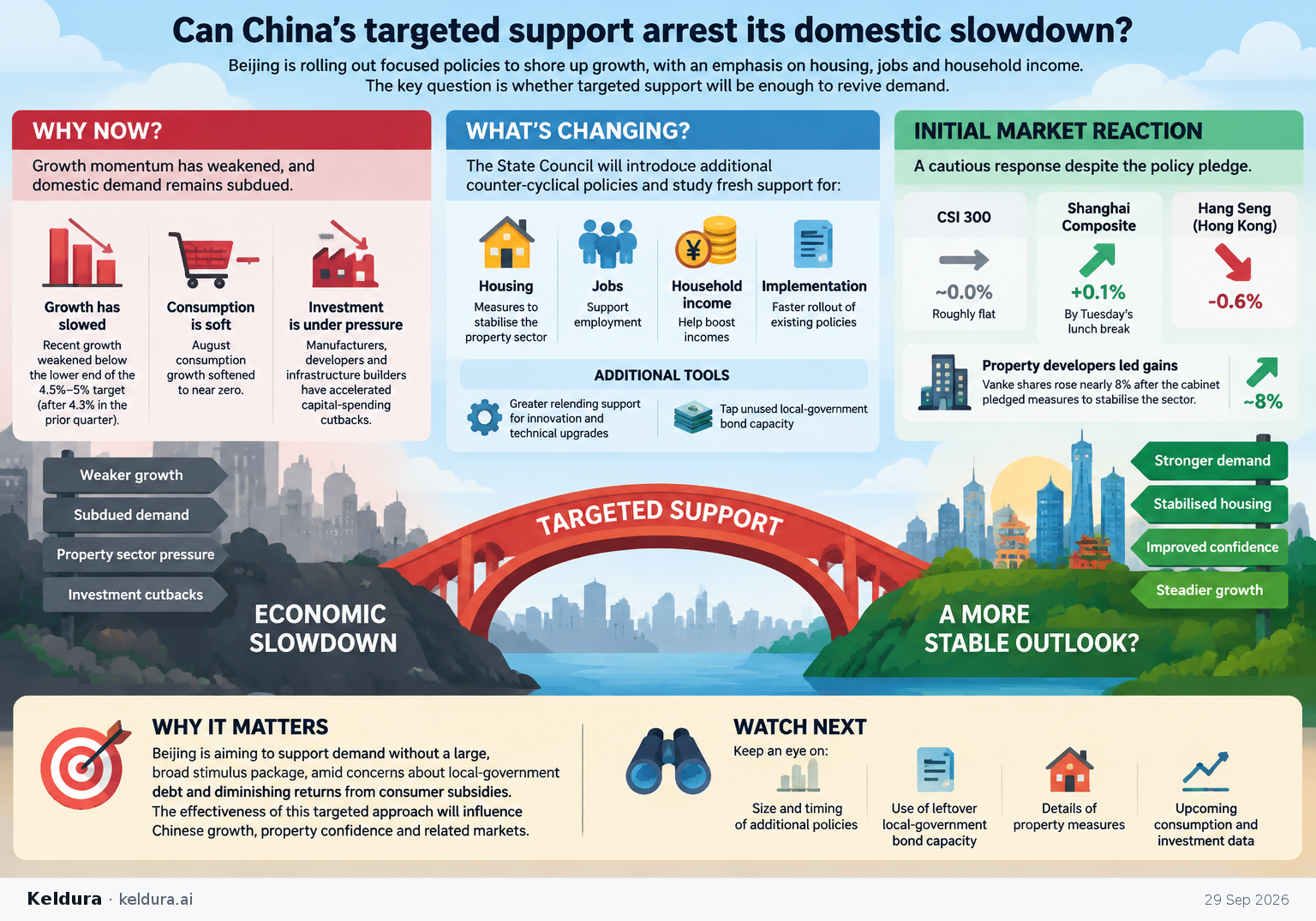
China’s cabinet said it would introduce a package of additional policies, tap unused local-government bond capacity and consider measures supporting property, employment and household income.[3] The signal followed indications that growth weakened below the lower end of the 4.5%-5% annual target after expanding 4.3% in the prior quarter, while consumption and investment remained subdued.[3]
Why it matters: Beijing is trying to support demand without relying on a large, broad stimulus package, reflecting concerns about local-government debt and diminishing returns from consumer subsidies; the effectiveness of its more targeted approach will influence Chinese growth, property confidence and related markets.[3]
Key insights: China’s blue-chip CSI300 was roughly flat and the Shanghai Composite gained 0.1% by Tuesday’s lunch break, while Hong Kong’s Hang Seng fell 0.6%, indicating a restrained initial market response.[2] | Mainland property developers led gains, with Vanke shares rising nearly 8% after the cabinet pledged measures to stabilise the sector.[2] | August consumption growth softened to near zero, while manufacturers, developers and infrastructure builders accelerated capital-spending cutbacks.[3] | Planned tools include greater relending support for innovation and technical upgrades alongside faster implementation of existing policies.[3]
Cheatsheet facts: What changed: The State Council promised additional counter-cyclical policies and said it would study fresh support for housing, jobs and household income.[3] | Why now: Growth momentum has weakened, domestic demand remains subdued, and the economy risks missing the lower end of its 4.5%-5% annual target.[3] | Watch next: Monitor the size and timing of additional policies, use of leftover local-government bond capacity, property measures and subsequent consumption and investment data.[3]
X copy pack
Edition complete
You've reached the end of this edition.