How did cheaper oil turn last week’s market headwinds into a Nasdaq record?
Global stocks rallied on Monday as oil and long-term bond yields fell, with AI chipmakers propelling the Nasdaq to a record close.
Brent crude settled near $100.34 after falling about 3.4%, while the 10-year Treasury yield eased below 5%; the S&P 500 gained 1.5% and the Nasdaq rose 2.3% to a record close.[2][4][5] The move spread overseas, with gains in European and Asian indexes, as investors also welcomed positive signals fr…
Brent crude settled near $100.34 after falling about 3.4%, while the 10-year Treasury yield eased below 5%; the S&P 500 gained 1.5% and the Nasdaq rose 2.3% to a record close.[2][4][5] The move spread overseas, with gains in European and Asian indexes, as investors also welcomed positive signals from US-China talks ahead of a presidential summit.[1][5]
Why it matters: Lower oil prices can ease energy-driven inflation pressure, while lower long-term yields reduce borrowing costs and make equities relatively more attractive; their simultaneous retreat therefore removed two pressures that had weighed on markets after the Federal Reserve raised rates.[1][5]
Key insights: The rally followed a clear sequence: hopes for Middle East talks pushed Brent briefly below $100, easing inflation anxiety and helping sovereign bonds before equity markets advanced.[1][2] | AI supplied the market’s second engine: the PHLX semiconductor index jumped 4.3%, Intel rose 12.2%, Arm Holdings gained 17%, and Advanced Micro Devices reached a $1 trillion market value for the first time.[2] | The rebound did not eliminate rate risk. Traders assigned a 50% probability to another Federal Reserve increase next month, and at least 10 central-bank policymakers were due to speak during the week.[2][4] | The global breadth was notable: London gained 0.8%, Paris and Frankfurt rose about 1%, Hong Kong advanced 1.2%, Shanghai gained 1%, and South Korea climbed 1.7%.[1]
Cheatsheet facts: What changed: Brent crude retreated toward $100, the 10-year Treasury yield fell below 5%, and the Nasdaq gained about 2.3% to a record close.[2][4][5] | Why now: Markets reacted to possible Middle East negotiations, encouraging US-China trade signals and evidence that AI investment was still expanding.[1][2] | Watch next: Watch Thursday’s Trump-Xi summit for any extension of the trade truce, alongside this week’s Federal Reserve commentary for signals about another rate increase.[1][2]
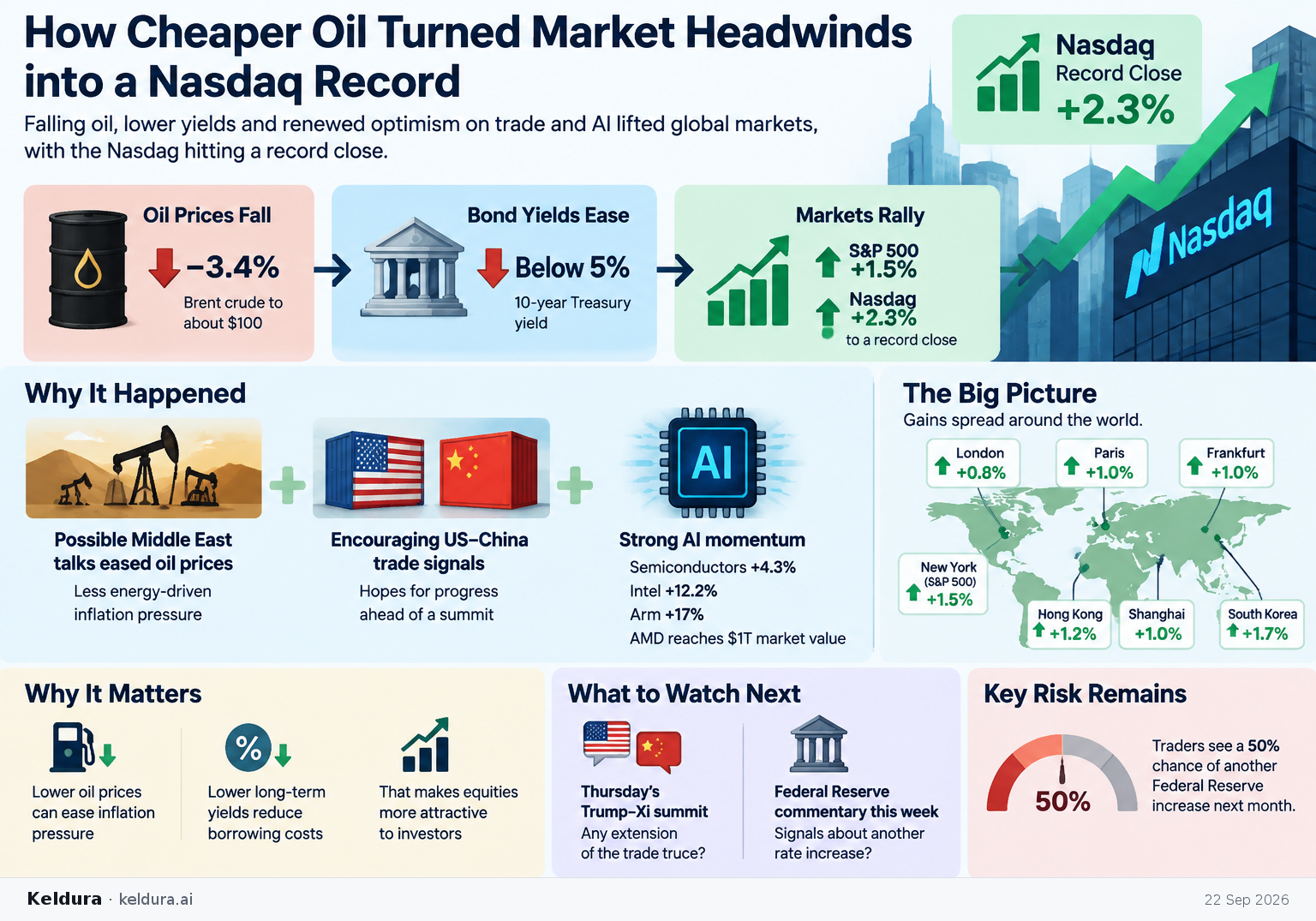
Brent crude settled near $100.34 after falling about 3.4%, while the 10-year Treasury yield eased below 5%; the S&P 500 gained 1.5% and the Nasdaq rose 2.3% to a record close.[2][4][5] The move spread overseas, with gains in European and Asian indexes, as investors also welcomed positive signals from US-China talks ahead of a presidential summit.[1][5]
Why it matters: Lower oil prices can ease energy-driven inflation pressure, while lower long-term yields reduce borrowing costs and make equities relatively more attractive; their simultaneous retreat therefore removed two pressures that had weighed on markets after the Federal Reserve raised rates.[1][5]
Key insights: The rally followed a clear sequence: hopes for Middle East talks pushed Brent briefly below $100, easing inflation anxiety and helping sovereign bonds before equity markets advanced.[1][2] | AI supplied the market’s second engine: the PHLX semiconductor index jumped 4.3%, Intel rose 12.2%, Arm Holdings gained 17%, and Advanced Micro Devices reached a $1 trillion market value for the first time.[2] | The rebound did not eliminate rate risk. Traders assigned a 50% probability to another Federal Reserve increase next month, and at least 10 central-bank policymakers were due to speak during the week.[2][4] | The global breadth was notable: London gained 0.8%, Paris and Frankfurt rose about 1%, Hong Kong advanced 1.2%, Shanghai gained 1%, and South Korea climbed 1.7%.[1]
Cheatsheet facts: What changed: Brent crude retreated toward $100, the 10-year Treasury yield fell below 5%, and the Nasdaq gained about 2.3% to a record close.[2][4][5] | Why now: Markets reacted to possible Middle East negotiations, encouraging US-China trade signals and evidence that AI investment was still expanding.[1][2] | Watch next: Watch Thursday’s Trump-Xi summit for any extension of the trade truce, alongside this week’s Federal Reserve commentary for signals about another rate increase.[1][2]
X copy pack
Edition complete
You've reached the end of this edition.
[2] US STOCKS-Nasdaq notches record-high close, AI optimism reignites and Treasury yields retreat | International — devdiscourse.com[4] Wall St surges on AI optimism as oil falls - RTHK — news.rthk.hk[5] Wall Street rallies within 0.4% of its record after oil prices and bond yields ease | Newser — newser.com[1] Global markets surge as oil prices fall, US-China trade hopes grow | Malay Mail — malaymail.comPost to X