How the Fed’s rate hike resets the inflation and borrowing-cost outlook
On September 16, the U.S. Federal Reserve raised its benchmark rate by a quarter point and signaled that more tightening could follow.
The Fed unanimously lifted its benchmark range to 3.75%-4.00%, its first increase since 2023, after inflation remained above its target amid energy, tariff and AI-investment pressures.[5] The new projections point to a 4.00%-4.25% rate by year-end and the same level at the end of 2027, while the pr…
The Fed unanimously lifted its benchmark range to 3.75%-4.00%, its first increase since 2023, after inflation remained above its target amid energy, tariff and AI-investment pressures.[5] The new projections point to a 4.00%-4.25% rate by year-end and the same level at the end of 2027, while the projected return of inflation to 2% was delayed until 2029.[4]
Why it matters: Higher policy rates can flow through to mortgages, auto loans and credit cards, tightening conditions for households and businesses.[7] The immediate market response included lower U.S. equities, while Treasury yields reflected expectations that borrowing costs could rise further.[6][7]
Key insights: The decision was not just a response to energy: the Fed dropped language attributing elevated inflation mainly to supply shocks, indicating concern that price pressures had become broader.[4] | Sixteen of 18 policymakers projected at least one additional increase this year, and four penciled in two more.[7] | Economic resilience gives the Fed room to tighten: August retail sales rose 1.2% from the previous month, while the central bank raised its year-end growth projection to 2.3%.[5][7] | Markets showed an uneven response: the Dow fell 1.21%, the S&P 500 declined 0.44% and the Nasdaq Composite was nearly flat, while energy shares dropped as crude prices eased.[6]
Cheatsheet facts: What changed: The FOMC unanimously raised its target range by 25 basis points to 3.75%-4.00%, the first increase since 2023.[5] | Why now: Inflation remained too high as energy disruption, tariffs and AI-related demand added price pressure, while consumer spending and economic growth stayed resilient.[5][7] | Watch next: Track incoming inflation readings and the Fed’s late-October decision; cooling inflation could change expectations, although 16 of 18 policymakers currently project at least one more hike this year.[7]
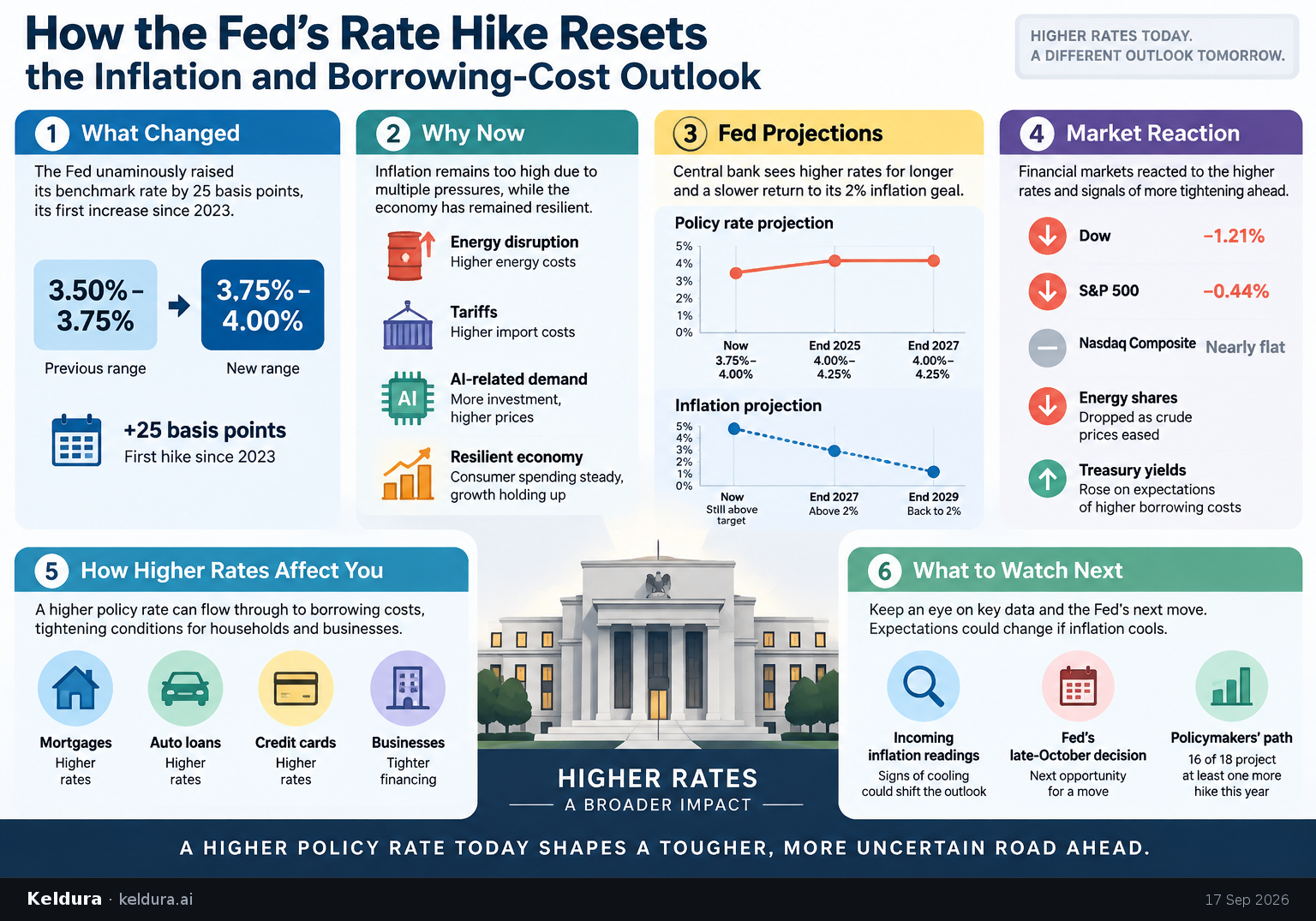
The Fed unanimously lifted its benchmark range to 3.75%-4.00%, its first increase since 2023, after inflation remained above its target amid energy, tariff and AI-investment pressures.[5] The new projections point to a 4.00%-4.25% rate by year-end and the same level at the end of 2027, while the projected return of inflation to 2% was delayed until 2029.[4]
Why it matters: Higher policy rates can flow through to mortgages, auto loans and credit cards, tightening conditions for households and businesses.[7] The immediate market response included lower U.S. equities, while Treasury yields reflected expectations that borrowing costs could rise further.[6][7]
Key insights: The decision was not just a response to energy: the Fed dropped language attributing elevated inflation mainly to supply shocks, indicating concern that price pressures had become broader.[4] | Sixteen of 18 policymakers projected at least one additional increase this year, and four penciled in two more.[7] | Economic resilience gives the Fed room to tighten: August retail sales rose 1.2% from the previous month, while the central bank raised its year-end growth projection to 2.3%.[5][7] | Markets showed an uneven response: the Dow fell 1.21%, the S&P 500 declined 0.44% and the Nasdaq Composite was nearly flat, while energy shares dropped as crude prices eased.[6]
Cheatsheet facts: What changed: The FOMC unanimously raised its target range by 25 basis points to 3.75%-4.00%, the first increase since 2023.[5] | Why now: Inflation remained too high as energy disruption, tariffs and AI-related demand added price pressure, while consumer spending and economic growth stayed resilient.[5][7] | Watch next: Track incoming inflation readings and the Fed’s late-October decision; cooling inflation could change expectations, although 16 of 18 policymakers currently project at least one more hike this year.[7]
X copy pack
Edition complete
You've reached the end of this edition.
[5] US Fed raises rates to tackle 'too high' inflation, irking Trump | AFP.com — afp.com[4] US Fed hikes rates, sees more tightening in search of ‘timelier’ drop in inflation | The Straits Times — straitstimes.com[7] Federal Reserve hikes key rate for 1st time in 3 years, defying Trump demands for a cut - ABC Columbia — abccolumbia.com[6] Wall Street ends lower after Fed hikes interest rates, sees more tightening ahead | The Straits Times — straitstimes.comPost to X