Oil surge sends bond yields higher and stocks lower
Renewed US-Iran hostilities lifted Brent crude to $94.65 and West Texas Intermediate to $90.22, while the 10-year Treasury yield approached 4.8%, its highest level since early 2025.[1][2] The Dow fell 0.79%, the S&P 500 lost 0.71% and the Nasdaq dropped 1.03% as investors confronted higher energy c…
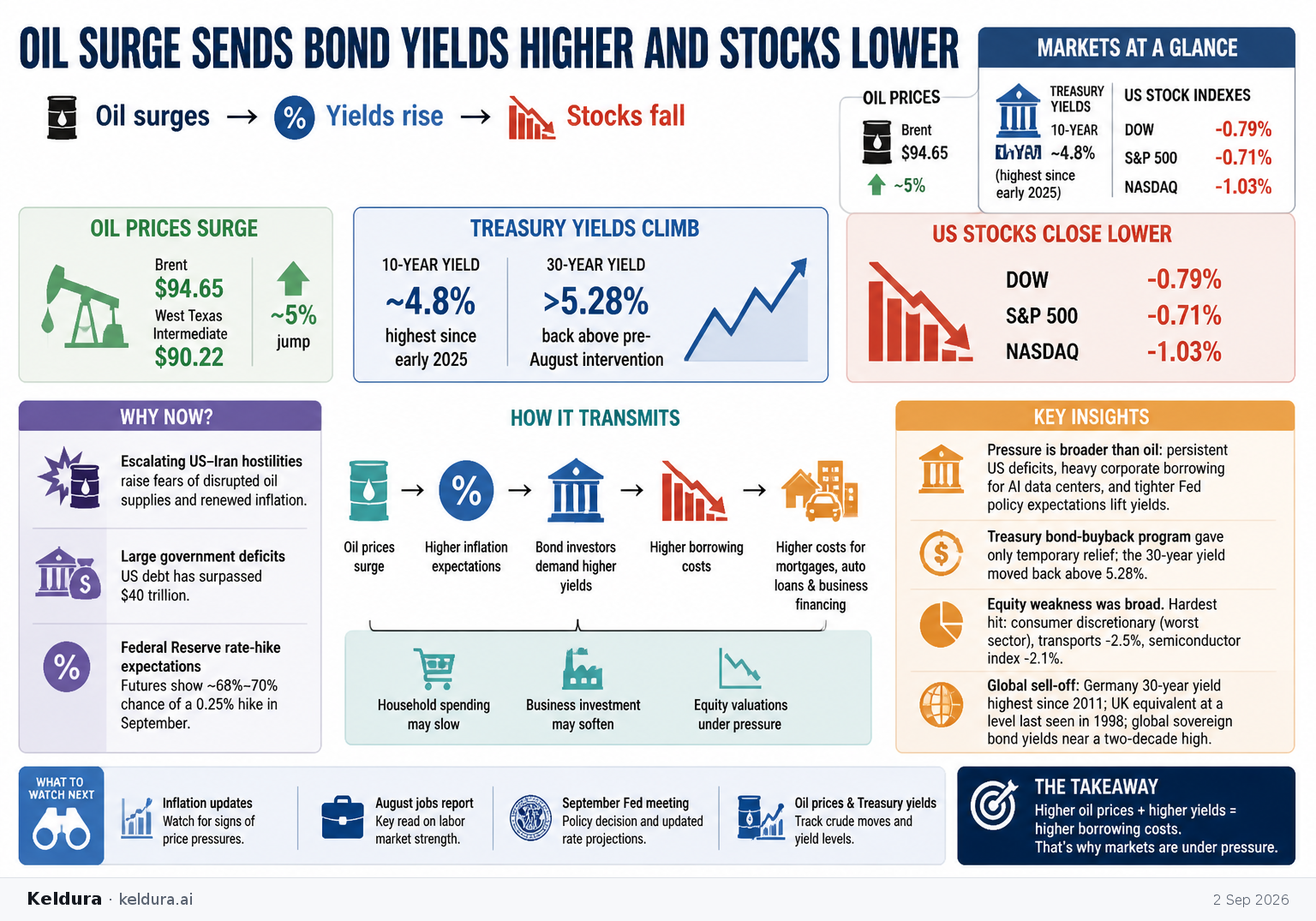
Renewed US-Iran hostilities lifted Brent crude to $94.65 and West Texas Intermediate to $90.22, while the 10-year Treasury yield approached 4.8%, its highest level since early 2025.[1][2] The Dow fell 0.79%, the S&P 500 lost 0.71% and the Nasdaq dropped 1.03% as investors confronted higher energy costs, inflation risks and borrowing costs.[2][5] Futures markets placed roughly a 68% to 70% probability on a quarter-point Federal Reserve rate increase in September.[2][4][5]
Why it matters: Higher Treasury yields feed into mortgages, auto loans and corporate financing, potentially restraining household spending, business expansion and equity valuations.[1][3] The sell-off is also testing governments with large deficits: the US debt recently surpassed $40 trillion, while long-dated sovereign yields have reached multiyear highs across Germany, the UK and Australia.[3][4]
Key insights: The pressure is broader than a short-term oil shock: persistent US deficits, heavy borrowing by technology companies for AI data centers and expectations of tighter Federal Reserve policy are also lifting yields.[1] | The Treasury’s expanded bond-buyback program provided only temporary relief; the 30-year yield moved back above 5.28%, near its level before the August intervention.[4] | Equity weakness was broad, but rate-sensitive and economically exposed groups were hit particularly hard: consumer discretionary led sector losses, transports fell 2.5% and the semiconductor index declined 2.1%.[5] | The sell-off is global, with Germany’s 30-year yield reaching its highest since 2011, the equivalent UK yield reaching a level last seen in 1998 and a global sovereign-bond yield index climbing to an almost two-decade high.[4]
Cheatsheet facts: What changed: Oil jumped about 5%, the 10-year Treasury yield neared 4.8%, the 30-year yield exceeded 5.28% and all three major US stock indexes closed lower.[2][4][5] | Why now: Escalating US-Iran fighting raised fears of disrupted oil supplies and renewed inflation, while large government deficits and Federal Reserve rate-hike expectations deepened the bond sell-off.[1][2][4] | Watch next: Watch the inflation updates and August jobs report ahead of the Federal Reserve’s September meeting, alongside observable moves in crude prices and Treasury yields.[2][3]
Renewed US-Iran hostilities lifted Brent crude to $94.65 and West Texas Intermediate to $90.22, while the 10-year Treasury yield approached 4.8%, its highest level since early 2025.[1][2] The Dow fell 0.79%, the S&P 500 lost 0.71% and the Nasdaq dropped 1.03% as investors confronted higher energy costs, inflation risks and borrowing costs.[2][5] Futures markets placed roughly a 68% to 70% probability on a quarter-point Federal Reserve rate increase in September.[2][4][5]
Why it matters: Higher Treasury yields feed into mortgages, auto loans and corporate financing, potentially restraining household spending, business expansion and equity valuations.[1][3] The sell-off is also testing governments with large deficits: the US debt recently surpassed $40 trillion, while long-dated sovereign yields have reached multiyear highs across Germany, the UK and Australia.[3][4]
Key insights: The pressure is broader than a short-term oil shock: persistent US deficits, heavy borrowing by technology companies for AI data centers and expectations of tighter Federal Reserve policy are also lifting yields.[1] | The Treasury’s expanded bond-buyback program provided only temporary relief; the 30-year yield moved back above 5.28%, near its level before the August intervention.[4] | Equity weakness was broad, but rate-sensitive and economically exposed groups were hit particularly hard: consumer discretionary led sector losses, transports fell 2.5% and the semiconductor index declined 2.1%.[5] | The sell-off is global, with Germany’s 30-year yield reaching its highest since 2011, the equivalent UK yield reaching a level last seen in 1998 and a global sovereign-bond yield index climbing to an almost two-decade high.[4]
Cheatsheet facts: What changed: Oil jumped about 5%, the 10-year Treasury yield neared 4.8%, the 30-year yield exceeded 5.28% and all three major US stock indexes closed lower.[2][4][5] | Why now: Escalating US-Iran fighting raised fears of disrupted oil supplies and renewed inflation, while large government deficits and Federal Reserve rate-hike expectations deepened the bond sell-off.[1][2][4] | Watch next: Watch the inflation updates and August jobs report ahead of the Federal Reserve’s September meeting, alongside observable moves in crude prices and Treasury yields.[2][3]
X copy pack
Edition complete
You've reached the end of this edition.
[1] Why bond yields are rising and why everyone should care | WBAL Baltimore News — wbal.com[2] Wall Street falls across the board as oil surges, bond yields spike on US-Iran clashes - The Herald Business — biz.heraldcorp.com[5] US stocks: Wall Street ends lower due to higher yields, rising oil prices - The Business Times — businesstimes.com.sg[4] Bessent's bond gains erased as US 30-year yield jumps, global yields hit multi-year highs - The Business Times — businesstimes.com.sg[3] Stocks slip on Wall Street under pressure from rising oil prices, bond sell-off | PBS News — pbs.orgPost to X