Europe and Central Asia are shifting FDI strategy from volume to value
A World Bank brief says countries across Europe and Central Asia are moving away from judging foreign direct investment only by volume and project counts [3]. Instead, governments are using investment strategy to target private capital that supports competitiveness, innovation, quality jobs, sustai…
A World Bank brief says countries across Europe and Central Asia are moving away from judging foreign direct investment only by volume and project counts [3]. Instead, governments are using investment strategy to target private capital that supports competitiveness, innovation, quality jobs, sustainability, and long-term resilience [3].
Why it matters: This matters because it changes how governments compete for capital: the goal is no longer simply to attract more FDI, but to attract investment that helps transform the economy [3]. That could reshape policy tools, the role of investment promotion agencies, and how countries measure success in a tighter, more selective global investment environment [3].
Key insights: The brief says FDI strategies are becoming practical tools for identifying priority sectors, coordinating reforms, and targeting investors with higher development impact [3]. | Countries are shifting beyond low-cost competition as sustainability rules tighten, supply chains reorganize, and labor markets become more constrained [3]. | New investment is moving into more capital-intensive and higher value-added activities, including automotive and transport equipment, higher-tech machinery, and electrical equipment [3]. | Investment promotion agencies are being asked to do more than marketing: they are now expected to support supplier linkages, aftercare, and decarbonization [3].
Cheatsheet facts: What changed: FDI policy is evolving from broad attraction campaigns toward strategy-led targeting of quality, higher-impact investment [3]. | Why now: Governments are reacting to tighter sustainability demands, shifting supply chains, and more constrained labor markets [3]. | Watch next: Monitor whether more countries adopt sector diagnostics, investment scans, and aftercare tools to target advanced manufacturing, renewables, and sustainable tourism [3].
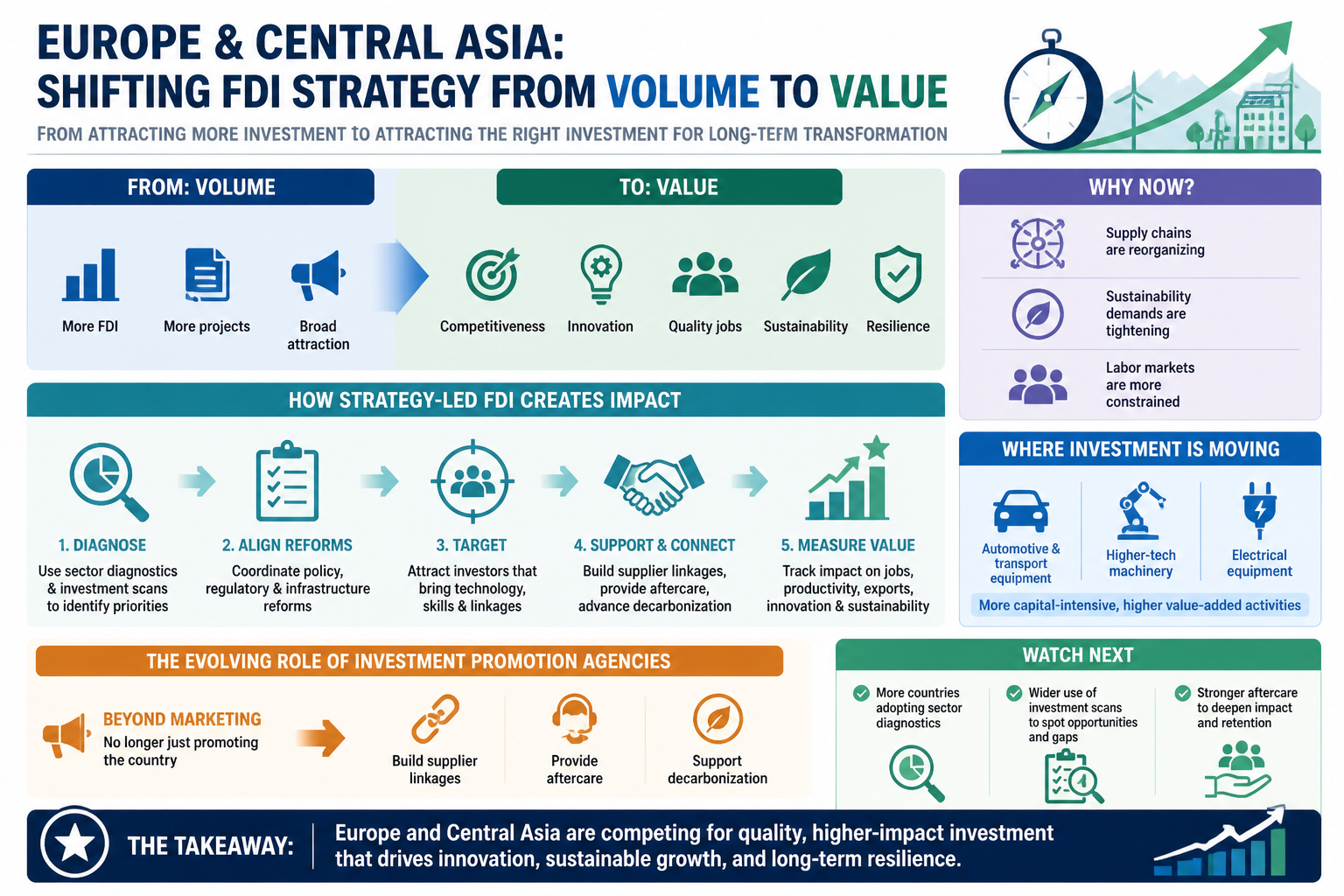
A World Bank brief says countries across Europe and Central Asia are moving away from judging foreign direct investment only by volume and project counts [3]. Instead, governments are using investment strategy to target private capital that supports competitiveness, innovation, quality jobs, sustainability, and long-term resilience [3].
Why it matters: This matters because it changes how governments compete for capital: the goal is no longer simply to attract more FDI, but to attract investment that helps transform the economy [3]. That could reshape policy tools, the role of investment promotion agencies, and how countries measure success in a tighter, more selective global investment environment [3].
Key insights: The brief says FDI strategies are becoming practical tools for identifying priority sectors, coordinating reforms, and targeting investors with higher development impact [3]. | Countries are shifting beyond low-cost competition as sustainability rules tighten, supply chains reorganize, and labor markets become more constrained [3]. | New investment is moving into more capital-intensive and higher value-added activities, including automotive and transport equipment, higher-tech machinery, and electrical equipment [3]. | Investment promotion agencies are being asked to do more than marketing: they are now expected to support supplier linkages, aftercare, and decarbonization [3].
Cheatsheet facts: What changed: FDI policy is evolving from broad attraction campaigns toward strategy-led targeting of quality, higher-impact investment [3]. | Why now: Governments are reacting to tighter sustainability demands, shifting supply chains, and more constrained labor markets [3]. | Watch next: Monitor whether more countries adopt sector diagnostics, investment scans, and aftercare tools to target advanced manufacturing, renewables, and sustainable tourism [3].
X copy pack
Edition complete
You've reached the end of this edition.