What does breaching seven planetary boundaries actually mean?
The breached boundaries are climate change, biosphere integrity, land-system change, freshwater change, biogeochemical flows, novel.
The breached boundaries are climate change, biosphere integrity, land-system change, freshwater change, biogeochemical flows, novel entities and ocean acidification; only stratospheric ozone depletion and atmospheric aerosol loading remain within the global safe zone.[1][5] Ocean acidification beca…
The breached boundaries are climate change, biosphere integrity, land-system change, freshwater change, biogeochemical flows, novel entities and ocean acidification; only stratospheric ozone depletion and atmospheric aerosol loading remain within the global safe zone.[1][5] Ocean acidification became the latest boundary to be crossed in 2025, and all seven breached indicators reached their highest recorded levels of deterioration.[1]
Why it matters: The framework tracks interacting pressures rather than isolated environmental problems: damage to climate, oceans, ecosystems, freshwater and soils can reinforce other stresses, increasing the risk of persistent and potentially irreversible change.[1][5]
Key insights: A boundary crossing is a risk indicator, not a switch marking immediate planetary collapse or a single global point of no return.[1] | Ocean acidification rises as seawater absorbs carbon dioxide, altering chemistry and reducing materials that corals, oysters and some plankton need to build shells and skeletons.[5] | Heatwaves, droughts, wildfires and ecosystem degradation can weaken forests, soils and other natural carbon sinks, creating feedback between ecological damage and atmospheric carbon.[1] | The ozone layer’s recovery shows that coordinated policy can reverse an adverse environmental trend, although the assessment says recovery has slowed.[1]
Cheatsheet facts: What changed: Ocean acidification joined six other breached boundaries in 2025, bringing the total outside the safe operating space to seven of nine.[1] | Why now: The 2026 assessment records continued deterioration across all seven breached boundaries and a shrinking margin for managing interconnected risks.[1][5] | Watch next: Track annual movement in the seven breached indicators and whether ozone recovery remains within the safe operating space despite its slowdown.[1]
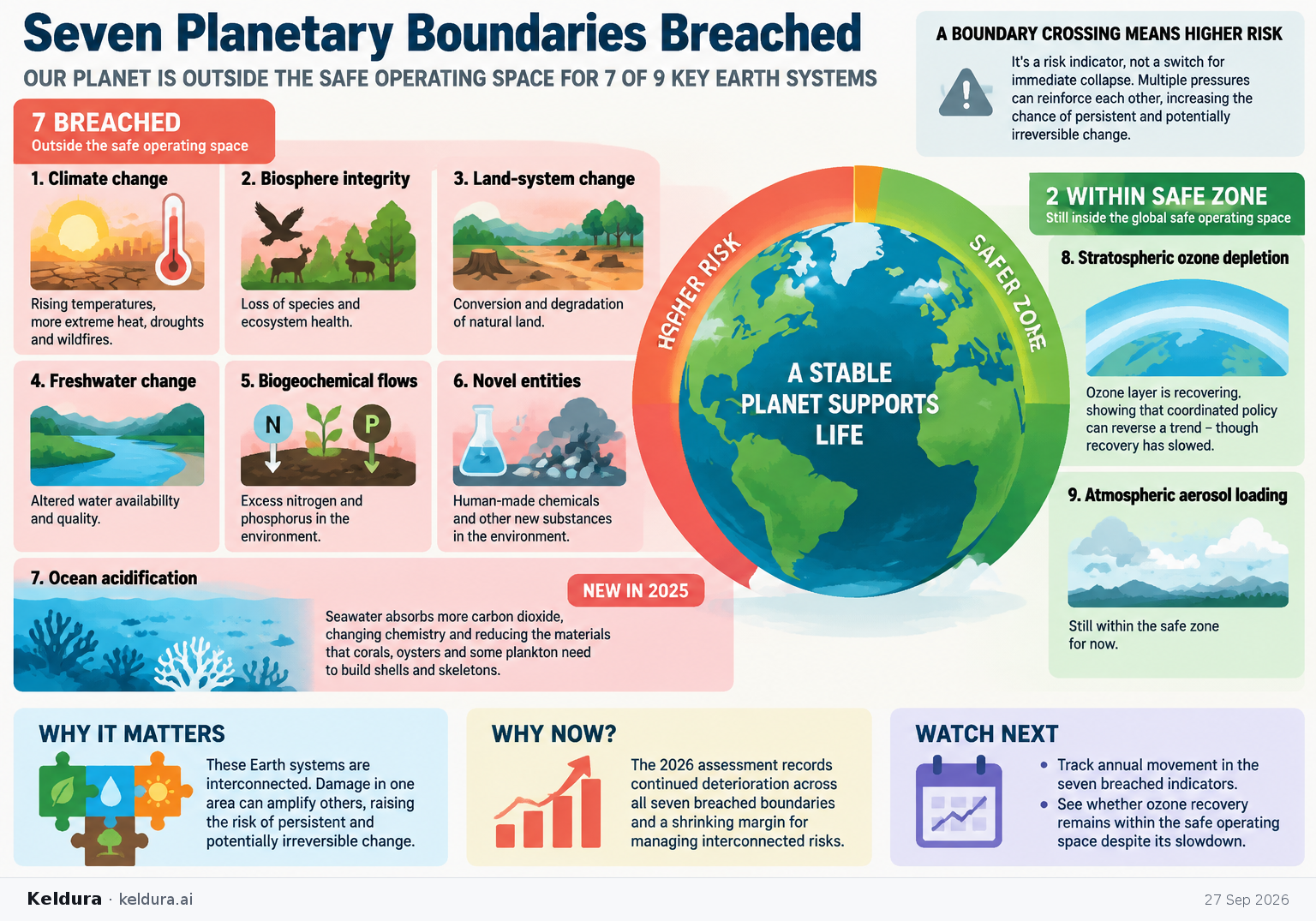
The breached boundaries are climate change, biosphere integrity, land-system change, freshwater change, biogeochemical flows, novel entities and ocean acidification; only stratospheric ozone depletion and atmospheric aerosol loading remain within the global safe zone.[1][5] Ocean acidification became the latest boundary to be crossed in 2025, and all seven breached indicators reached their highest recorded levels of deterioration.[1]
Why it matters: The framework tracks interacting pressures rather than isolated environmental problems: damage to climate, oceans, ecosystems, freshwater and soils can reinforce other stresses, increasing the risk of persistent and potentially irreversible change.[1][5]
Key insights: A boundary crossing is a risk indicator, not a switch marking immediate planetary collapse or a single global point of no return.[1] | Ocean acidification rises as seawater absorbs carbon dioxide, altering chemistry and reducing materials that corals, oysters and some plankton need to build shells and skeletons.[5] | Heatwaves, droughts, wildfires and ecosystem degradation can weaken forests, soils and other natural carbon sinks, creating feedback between ecological damage and atmospheric carbon.[1] | The ozone layer’s recovery shows that coordinated policy can reverse an adverse environmental trend, although the assessment says recovery has slowed.[1]
Cheatsheet facts: What changed: Ocean acidification joined six other breached boundaries in 2025, bringing the total outside the safe operating space to seven of nine.[1] | Why now: The 2026 assessment records continued deterioration across all seven breached boundaries and a shrinking margin for managing interconnected risks.[1][5] | Watch next: Track annual movement in the seven breached indicators and whether ozone recovery remains within the safe operating space despite its slowdown.[1]
X copy pack
Edition complete
You've reached the end of this edition.