How warming helped destabilize the Nepal-Tibet mountainside
World Weather Attribution researchers described the disaster as a compound event involving rising temperatures, thinning glaciers, thawing.
World Weather Attribution researchers described the disaster as a compound event involving rising temperatures, thinning glaciers, thawing permafrost and pre-existing geological weaknesses.[6] Climate change was highly likely to have contributed to the collapse of roughly 2 square kilometres of roc…
World Weather Attribution researchers described the disaster as a compound event involving rising temperatures, thinning glaciers, thawing permafrost and pre-existing geological weaknesses.[6] Climate change was highly likely to have contributed to the collapse of roughly 2 square kilometres of rock wall and glacier ice, although researchers could not assign it a precise share of responsibility.[3]
Why it matters: The findings show how warming can act as a destabilizing factor on already vulnerable mountain terrain rather than serving as a single, isolated trigger, complicating risk assessment across glacier-covered regions.[3][6]
Key insights: July and August temperatures in the area were about 1.5°C warmer because of human influence on the climate, according to the attribution study.[6] | Regional glaciers had been thinning by roughly half a metre annually, potentially weakening fractures and increasing instability.[6] | Heavy snowfall in October and November contributed to substantial meltwater early in the year, adding another element to the compound event.[6] | Researchers said the slope may also have been weakened by the 2015 magnitude-7.8 earthquake and its rock-ice avalanche.[6]
Cheatsheet facts: What changed: Scientists linked the collapse to interacting climatic and geological stresses rather than to one trigger.[3][6] | Why now: Human-influenced heat, long-term glacier thinning, permafrost retreat, meltwater and existing slope weaknesses combined to increase instability.[6] | Watch next: Nepali Prime Minister Balendra Shah is set to raise the disaster and climate justice at the United Nations General Assembly in New York.[6]
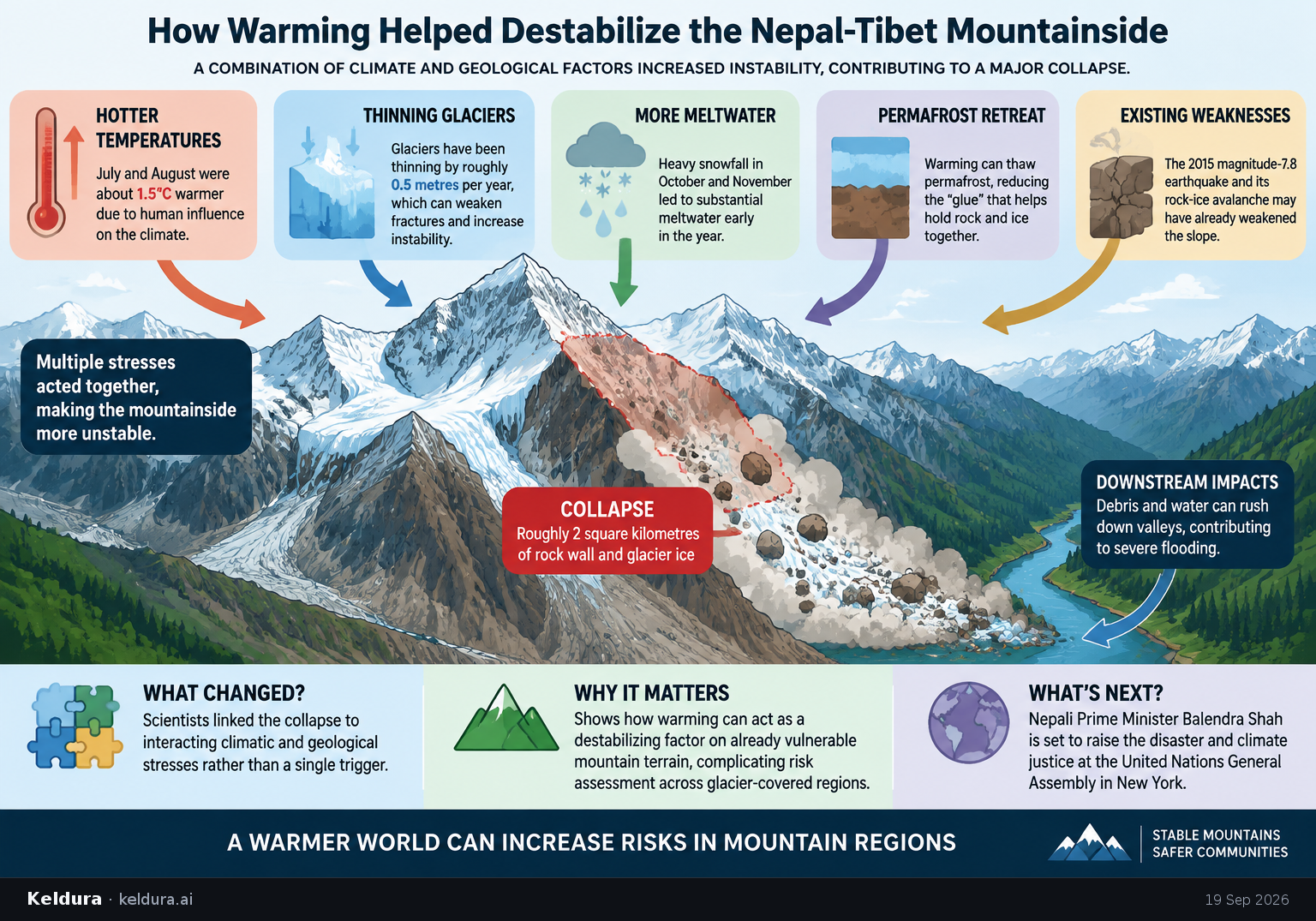
World Weather Attribution researchers described the disaster as a compound event involving rising temperatures, thinning glaciers, thawing permafrost and pre-existing geological weaknesses.[6] Climate change was highly likely to have contributed to the collapse of roughly 2 square kilometres of rock wall and glacier ice, although researchers could not assign it a precise share of responsibility.[3]
Why it matters: The findings show how warming can act as a destabilizing factor on already vulnerable mountain terrain rather than serving as a single, isolated trigger, complicating risk assessment across glacier-covered regions.[3][6]
Key insights: July and August temperatures in the area were about 1.5°C warmer because of human influence on the climate, according to the attribution study.[6] | Regional glaciers had been thinning by roughly half a metre annually, potentially weakening fractures and increasing instability.[6] | Heavy snowfall in October and November contributed to substantial meltwater early in the year, adding another element to the compound event.[6] | Researchers said the slope may also have been weakened by the 2015 magnitude-7.8 earthquake and its rock-ice avalanche.[6]
Cheatsheet facts: What changed: Scientists linked the collapse to interacting climatic and geological stresses rather than to one trigger.[3][6] | Why now: Human-influenced heat, long-term glacier thinning, permafrost retreat, meltwater and existing slope weaknesses combined to increase instability.[6] | Watch next: Nepali Prime Minister Balendra Shah is set to raise the disaster and climate justice at the United Nations General Assembly in New York.[6]
X copy pack
Edition complete
You've reached the end of this edition.