How the US power-plant rollback changes the emissions trajectory
The Trump administration this week dismantled most federal carbon limits for power plants and moved to remove the remaining requirements.
The EPA finalized a plan gutting the 2024 Carbon Pollution Standards and proposed revoking all remaining greenhouse-gas requirements for power plants, arguing that the required control technologies were insufficiently demonstrated and that sector emissions have no material climate impact.[6] Combin…
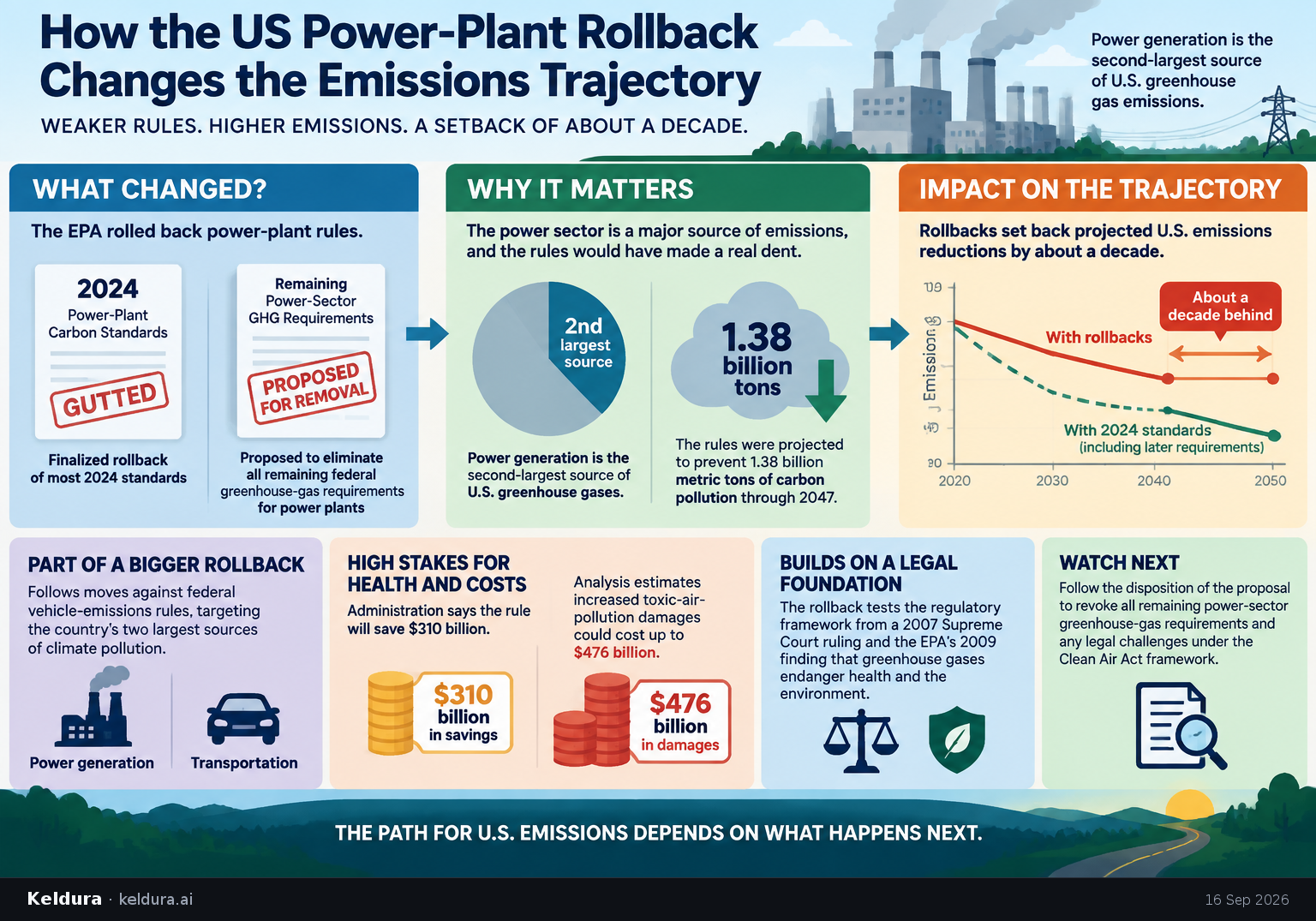
The EPA finalized a plan gutting the 2024 Carbon Pollution Standards and proposed revoking all remaining greenhouse-gas requirements for power plants, arguing that the required control technologies were insufficiently demonstrated and that sector emissions have no material climate impact.[6] Combined with earlier federal rollbacks, the move has set back projected US emissions reductions by about a decade.[7]
Why it matters: Power generation is the United States’ second-largest source of greenhouse gases, and the discarded standards were projected to prevent 1.38 billion metric tons of carbon pollution through 2047.[6] The rollback also tests the regulatory framework built on the Supreme Court’s 2007 ruling and the EPA’s 2009 finding that greenhouse gases endanger health and the environment.[6]
Key insights: The power-sector action follows moves against federal vehicle-emissions regulation, targeting the country’s two largest sources of climate pollution.[6] | The administration says its finalized power rule will save $310 billion, while a Resources for the Future analysis estimates that increased toxic-air-pollution damages could cost up to $476 billion.[6] | The EPA finalized the rollback of most 2024 standards while separately proposing to rescind every remaining greenhouse-gas standard for the power sector.[6]
Cheatsheet facts: What changed: The EPA gutted the 2024 power-plant carbon standards and proposed eliminating the remaining federal greenhouse-gas requirements for the sector.[6] | Why now: The action continues the administration’s wider rollback of greenhouse-gas rules governing power generation and transportation.[6][7] | Watch next: Watch the disposition of the proposal to revoke all remaining power-sector greenhouse-gas requirements and any legal challenges invoking the Clean Air Act framework.[6]
The EPA finalized a plan gutting the 2024 Carbon Pollution Standards and proposed revoking all remaining greenhouse-gas requirements for power plants, arguing that the required control technologies were insufficiently demonstrated and that sector emissions have no material climate impact.[6] Combined with earlier federal rollbacks, the move has set back projected US emissions reductions by about a decade.[7]
Why it matters: Power generation is the United States’ second-largest source of greenhouse gases, and the discarded standards were projected to prevent 1.38 billion metric tons of carbon pollution through 2047.[6] The rollback also tests the regulatory framework built on the Supreme Court’s 2007 ruling and the EPA’s 2009 finding that greenhouse gases endanger health and the environment.[6]
Key insights: The power-sector action follows moves against federal vehicle-emissions regulation, targeting the country’s two largest sources of climate pollution.[6] | The administration says its finalized power rule will save $310 billion, while a Resources for the Future analysis estimates that increased toxic-air-pollution damages could cost up to $476 billion.[6] | The EPA finalized the rollback of most 2024 standards while separately proposing to rescind every remaining greenhouse-gas standard for the power sector.[6]
Cheatsheet facts: What changed: The EPA gutted the 2024 power-plant carbon standards and proposed eliminating the remaining federal greenhouse-gas requirements for the sector.[6] | Why now: The action continues the administration’s wider rollback of greenhouse-gas rules governing power generation and transportation.[6][7] | Watch next: Watch the disposition of the proposal to revoke all remaining power-sector greenhouse-gas requirements and any legal challenges invoking the Clean Air Act framework.[6]
X copy pack
Edition complete
You've reached the end of this edition.