How the EPA rollback dismantles power-sector climate controls
On Monday, the Trump administration moved to eliminate federal greenhouse-gas limits for coal- and gas-fired power plants.
The EPA finalized a rollback of most 2024 Carbon Pollution Standards and proposed revoking the remaining power-plant greenhouse-gas requirements, arguing that required control technologies were not adequately demonstrated and that the sector has no material effect on climate change.[1] The Biden-er…
The EPA finalized a rollback of most 2024 Carbon Pollution Standards and proposed revoking the remaining power-plant greenhouse-gas requirements, arguing that required control technologies were not adequately demonstrated and that the sector has no material effect on climate change.[1] The Biden-era rule would have required affected plants to capture and store at least 90% of their carbon pollution by 2032, while the Trump EPA says its repeal will save industry more than $300 billion.[3]
Why it matters: Power plants are the second-largest source of U.S. climate pollution, so the action follows the administration's repeal of rules covering vehicles, the largest source.[1][3] If the rollback survives expected litigation, it could impede future administrations from requiring coal- and gas-fired plants to limit planet-warming pollution, although the court fight could last for years.[3]
Key insights: Biden's EPA projected that the standards would prevent 1.38 billion metric tons of carbon pollution through 2047.[1] | The Trump EPA claims roughly $310 billion in savings, while a Resources for the Future analysis estimated that added toxic pollution could cause as much as $476 billion in health damages.[1] | Experts cited by the Los Angeles Times estimate that the rollback could add as much as 5.8 billion metric tons of carbon dioxide emissions by 2050.[4] | For 2035 alone, the previous administration estimated that the rule would prevent 1,200 premature deaths, 360,000 cases of asthma symptoms and 47,000 lost workdays.[3]
Cheatsheet facts: What changed: The EPA overturned most 2024 power-plant carbon limits and proposed removing every remaining greenhouse-gas standard for the sector.[1] | Why now: The administration says carbon-capture requirements exceed EPA authority and that repeal will lower industry costs and expand coal and natural-gas use.[1][3] | Watch next: Court filings from environmental groups and rulings on whether the repeal and its legal rationale can take effect will determine the rollback's durability.[3]
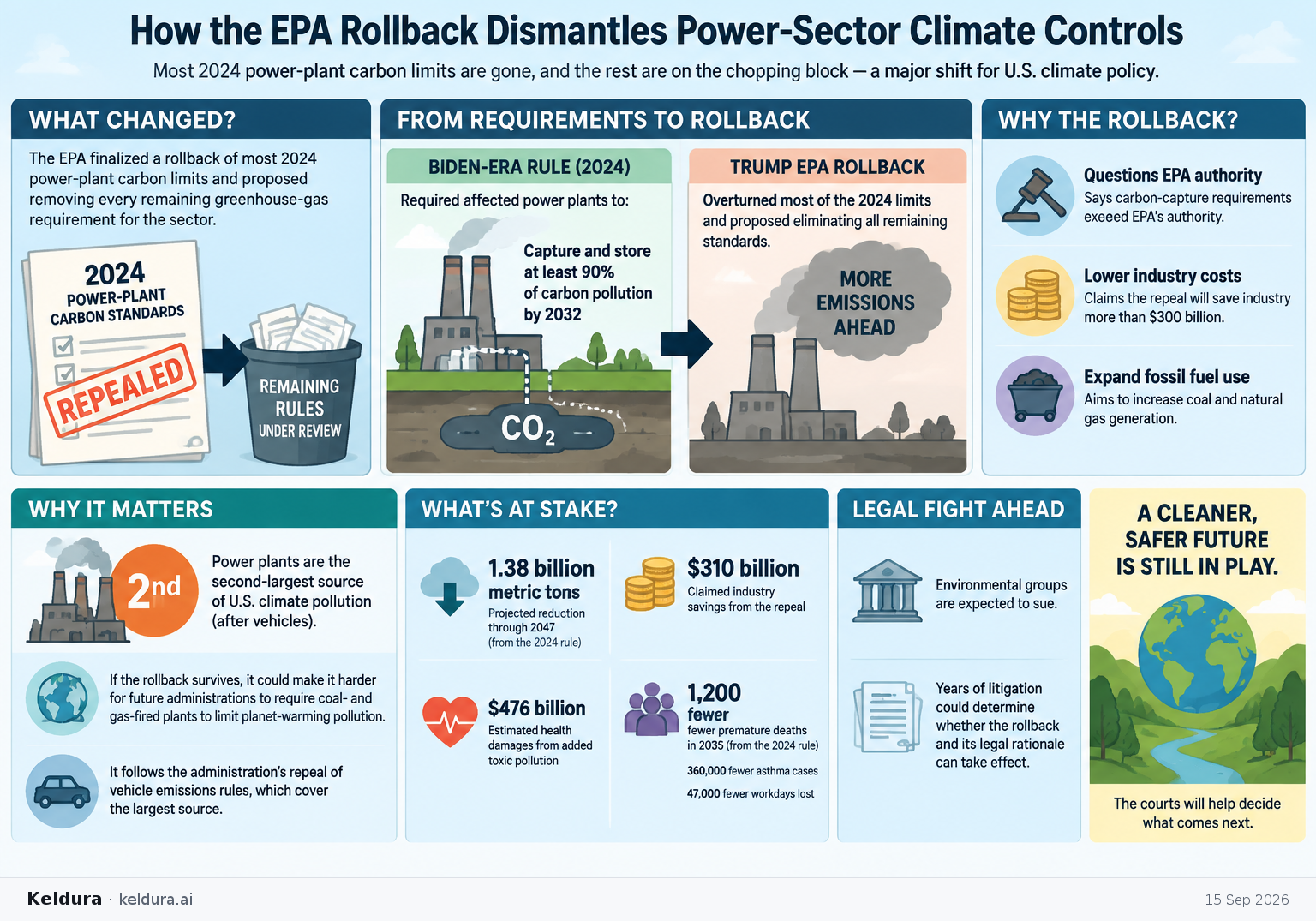
The EPA finalized a rollback of most 2024 Carbon Pollution Standards and proposed revoking the remaining power-plant greenhouse-gas requirements, arguing that required control technologies were not adequately demonstrated and that the sector has no material effect on climate change.[1] The Biden-era rule would have required affected plants to capture and store at least 90% of their carbon pollution by 2032, while the Trump EPA says its repeal will save industry more than $300 billion.[3]
Why it matters: Power plants are the second-largest source of U.S. climate pollution, so the action follows the administration's repeal of rules covering vehicles, the largest source.[1][3] If the rollback survives expected litigation, it could impede future administrations from requiring coal- and gas-fired plants to limit planet-warming pollution, although the court fight could last for years.[3]
Key insights: Biden's EPA projected that the standards would prevent 1.38 billion metric tons of carbon pollution through 2047.[1] | The Trump EPA claims roughly $310 billion in savings, while a Resources for the Future analysis estimated that added toxic pollution could cause as much as $476 billion in health damages.[1] | Experts cited by the Los Angeles Times estimate that the rollback could add as much as 5.8 billion metric tons of carbon dioxide emissions by 2050.[4] | For 2035 alone, the previous administration estimated that the rule would prevent 1,200 premature deaths, 360,000 cases of asthma symptoms and 47,000 lost workdays.[3]
Cheatsheet facts: What changed: The EPA overturned most 2024 power-plant carbon limits and proposed removing every remaining greenhouse-gas standard for the sector.[1] | Why now: The administration says carbon-capture requirements exceed EPA authority and that repeal will lower industry costs and expand coal and natural-gas use.[1][3] | Watch next: Court filings from environmental groups and rulings on whether the repeal and its legal rationale can take effect will determine the rollback's durability.[3]
X copy pack
Edition complete
You've reached the end of this edition.