U.N. warns climate overshoot could crowd out the energy transition
A new U.N. Environment Programme report says humanity is highly likely to exceed the 1.5-degree Celsius warming threshold [4]. It warns that prolonged overshoot could force governments to direct fiscal, administrative and political capacity toward disaster relief and reconstruction, crowding out cl…
A new U.N. Environment Programme report says humanity is highly likely to exceed the 1.5-degree Celsius warming threshold [4]. It warns that prolonged overshoot could force governments to direct fiscal, administrative and political capacity toward disaster relief and reconstruction, crowding out clean-energy and climate-resilience investment [4].
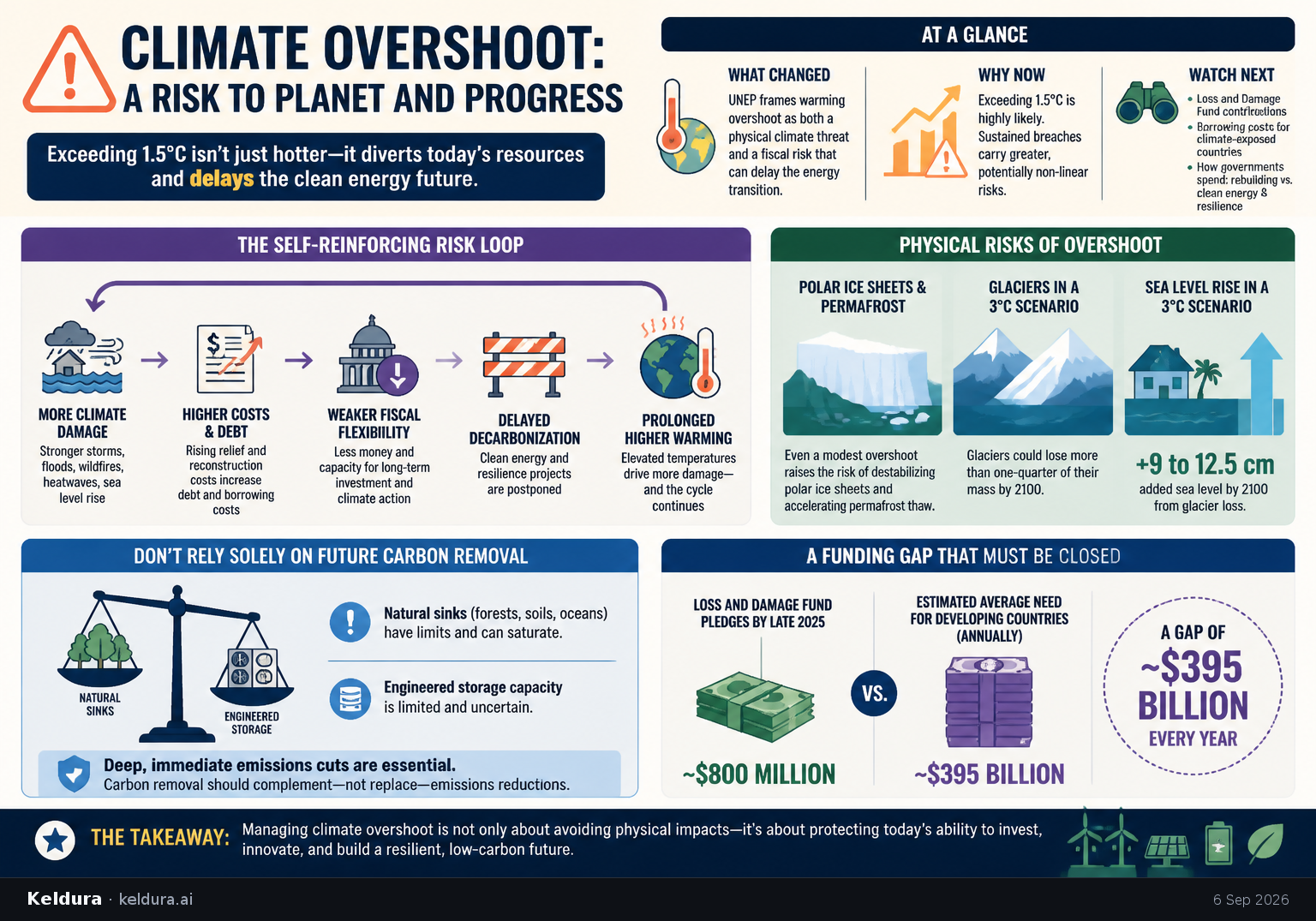
Why it matters: The report identifies a self-reinforcing risk: more climate damage can increase debt and borrowing costs, weaken governments’ fiscal flexibility and delay decarbonization, thereby prolonging elevated warming [4].
Key insights: Even a modest overshoot could increase the risk of destabilizing polar ice sheets and accelerating permafrost thaw [4]. | In a 3-degree Celsius scenario, glaciers could lose more than one-quarter of their mass by 2100 and add an estimated 9 to 12.5 centimeters to sea levels [4]. | The report cautions against relying solely on future carbon removal, noting limits on natural sinks and engineered storage capacity [4]. | By late 2025, Loss and Damage Fund pledges totaled about $800 million, versus an estimated average developing-country need of $395 billion annually for loss, damage and adaptation [4].
Cheatsheet facts: What changed: UNEP has framed warming overshoot as both a physical climate threat and a fiscal risk capable of delaying the energy transition [4]. | Why now: The report says exceeding 1.5 degrees Celsius is highly likely and warns that sustained breaches carry greater, potentially non-linear risks [4]. | Watch next: Monitor Loss and Damage Fund contributions, climate-exposed countries’ borrowing costs, and government spending shifts between disaster reconstruction and clean-energy or resilience projects [4].
A new U.N. Environment Programme report says humanity is highly likely to exceed the 1.5-degree Celsius warming threshold [4]. It warns that prolonged overshoot could force governments to direct fiscal, administrative and political capacity toward disaster relief and reconstruction, crowding out clean-energy and climate-resilience investment [4].
Why it matters: The report identifies a self-reinforcing risk: more climate damage can increase debt and borrowing costs, weaken governments’ fiscal flexibility and delay decarbonization, thereby prolonging elevated warming [4].
Key insights: Even a modest overshoot could increase the risk of destabilizing polar ice sheets and accelerating permafrost thaw [4]. | In a 3-degree Celsius scenario, glaciers could lose more than one-quarter of their mass by 2100 and add an estimated 9 to 12.5 centimeters to sea levels [4]. | The report cautions against relying solely on future carbon removal, noting limits on natural sinks and engineered storage capacity [4]. | By late 2025, Loss and Damage Fund pledges totaled about $800 million, versus an estimated average developing-country need of $395 billion annually for loss, damage and adaptation [4].
Cheatsheet facts: What changed: UNEP has framed warming overshoot as both a physical climate threat and a fiscal risk capable of delaying the energy transition [4]. | Why now: The report says exceeding 1.5 degrees Celsius is highly likely and warns that sustained breaches carry greater, potentially non-linear risks [4]. | Watch next: Monitor Loss and Damage Fund contributions, climate-exposed countries’ borrowing costs, and government spending shifts between disaster reconstruction and clean-energy or resilience projects [4].
X copy pack
Edition complete
You've reached the end of this edition.