COP17 fails to break deadlock over a global drought framework
Governments at UNCCD COP17 in Ulaanbaatar again failed to agree on either a binding or voluntary global drought framework after two years of negotiations.[3] The unresolved framework was intended to shift drought policy from crisis response toward national planning, shared early-warning systems, da…
Governments at UNCCD COP17 in Ulaanbaatar again failed to agree on either a binding or voluntary global drought framework after two years of negotiations.[3] The unresolved framework was intended to shift drought policy from crisis response toward national planning, shared early-warning systems, data coordination and resilience finance.[3] Governments did agree to make drought a permanent standalone agenda item at COP18 and subsequent ordinary sessions.[3]
Why it matters: The deadlock leaves no coordinated global mechanism to close an estimated $278 billion annual gap in land-restoration and drought-resilience investment, even though one in four people was affected by drought in 2022-23.[3] Elevating drought on future agendas secures negotiating space but does not itself create the planning, monitoring or financing architecture under discussion.[3]
Key insights: A small group of countries, led most vocally by the US, opposed both binding and voluntary options over concerns including sovereignty, budgets and new bureaucracy.[3] | A binding protocol would have required national implementation and developed-country financing obligations, while a voluntary framework would have offered similar coordination without binding duties.[3] | The proposed framework would have supported monitoring of rainfall, soil moisture, vulnerability and exposure while creating channels for scientific and socioeconomic data sharing.[3] | Negotiations will continue at COP18 in Sharm El-Sheikh, building on discussions at COP16 and COP17.[3]
Cheatsheet facts: What changed: COP17 closed without agreement on a global drought framework, but drought gained permanent standalone status on the agenda for COP18 and later sessions.[3] | Why now: Negotiators remained divided over legal obligations, sovereignty, financing and whether a new framework would expand UNCCD bureaucracy and budgets.[3] | Watch next: Watch whether COP18 in Sharm El-Sheikh produces an agreed instrument for proactive drought management and whether binding, voluntary or alternative options remain bracketed.[3]
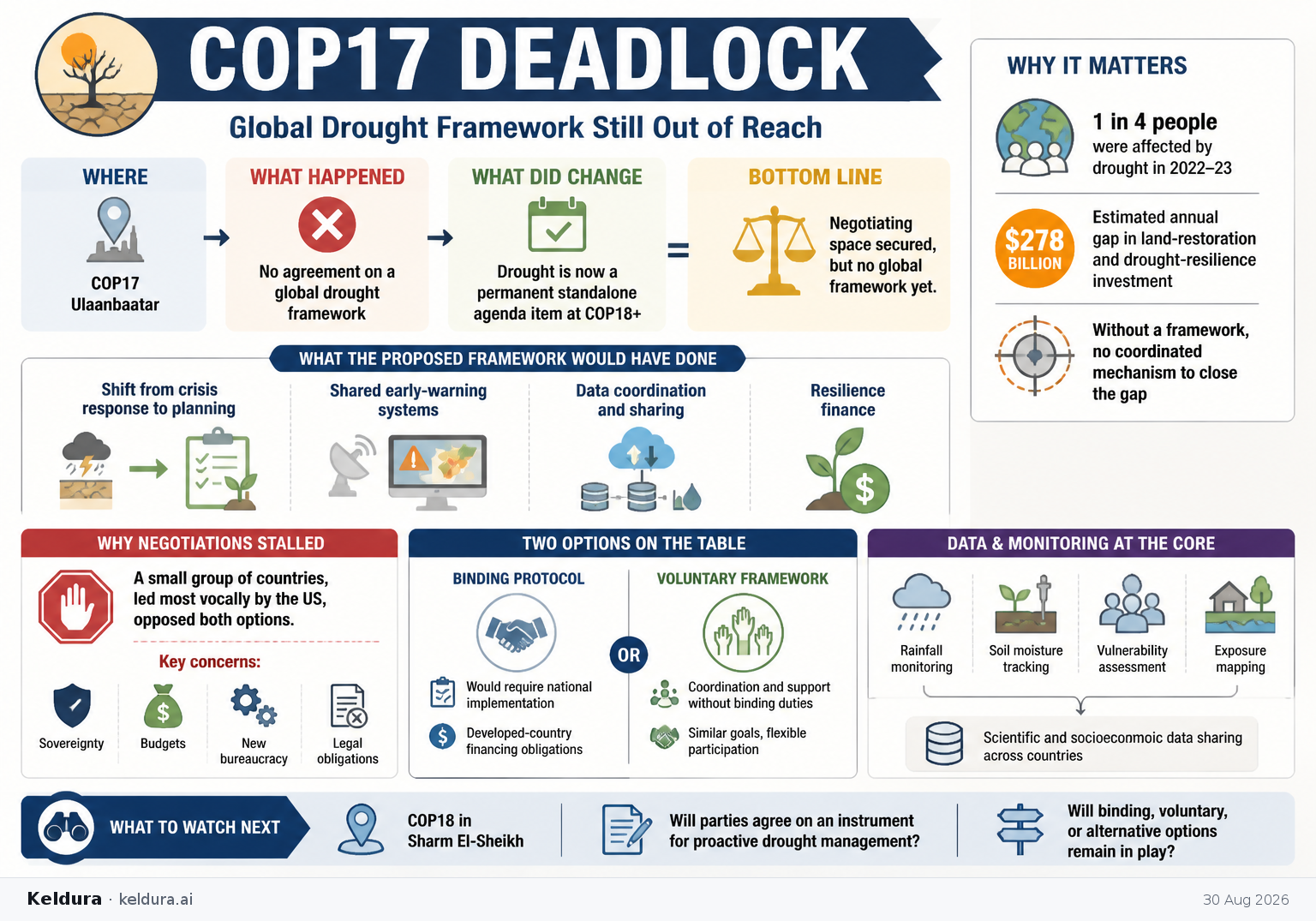
Governments at UNCCD COP17 in Ulaanbaatar again failed to agree on either a binding or voluntary global drought framework after two years of negotiations.[3] The unresolved framework was intended to shift drought policy from crisis response toward national planning, shared early-warning systems, data coordination and resilience finance.[3] Governments did agree to make drought a permanent standalone agenda item at COP18 and subsequent ordinary sessions.[3]
Why it matters: The deadlock leaves no coordinated global mechanism to close an estimated $278 billion annual gap in land-restoration and drought-resilience investment, even though one in four people was affected by drought in 2022-23.[3] Elevating drought on future agendas secures negotiating space but does not itself create the planning, monitoring or financing architecture under discussion.[3]
Key insights: A small group of countries, led most vocally by the US, opposed both binding and voluntary options over concerns including sovereignty, budgets and new bureaucracy.[3] | A binding protocol would have required national implementation and developed-country financing obligations, while a voluntary framework would have offered similar coordination without binding duties.[3] | The proposed framework would have supported monitoring of rainfall, soil moisture, vulnerability and exposure while creating channels for scientific and socioeconomic data sharing.[3] | Negotiations will continue at COP18 in Sharm El-Sheikh, building on discussions at COP16 and COP17.[3]
Cheatsheet facts: What changed: COP17 closed without agreement on a global drought framework, but drought gained permanent standalone status on the agenda for COP18 and later sessions.[3] | Why now: Negotiators remained divided over legal obligations, sovereignty, financing and whether a new framework would expand UNCCD bureaucracy and budgets.[3] | Watch next: Watch whether COP18 in Sharm El-Sheikh produces an agreed instrument for proactive drought management and whether binding, voluntary or alternative options remain bracketed.[3]
X copy pack
Edition complete
You've reached the end of this edition.