How is global warming amplifying El Niño?
The research found El Niños are more than 36% stronger than before the industrial era, including a 16% increase in the past 40 years.
The research found El Niños are more than 36% stronger than before the industrial era, including a 16% increase in the past 40 years.[3] El Niño naturally occurs every two to seven years when the eastern tropical Pacific warms, but the new study provides evidence that fossil-fuel-driven planetary h…
The research found El Niños are more than 36% stronger than before the industrial era, including a 16% increase in the past 40 years.[3] El Niño naturally occurs every two to seven years when the eastern tropical Pacific warms, but the new study provides evidence that fossil-fuel-driven planetary heating is amplifying the pattern.[4][5]
Why it matters: Because El Niño shifts weather around the world and raises global temperatures, a stronger baseline pattern can intensify extreme-event and food-security risks far beyond the tropical Pacific.[3][4]
Key insights: El Niño is a temporary warming of parts of the equatorial Pacific that disrupts weather patterns worldwide.[3] | The latest event is forecast to become the strongest since at least 1950 and potentially the strongest in living memory.[4][6] | The findings address a long-running scientific debate over whether El Niño’s severity is influenced by climate change rather than remaining entirely natural.[5] | The measured strengthening has accelerated, with a 16% increase occurring in only the past four decades.[3]
Cheatsheet facts: What changed: Researchers quantified El Niño as more than 36% stronger than in the preindustrial era, with a 16% rise in the past 40 years.[3] | Why now: The study arrived as a strong El Niño gathers strength in the tropical Pacific and is forecast to challenge historical records.[3][6] | Watch next: The developing event’s measured peak later this year and whether it exceeds the strength of El Niños recorded since 1950.[4][6]
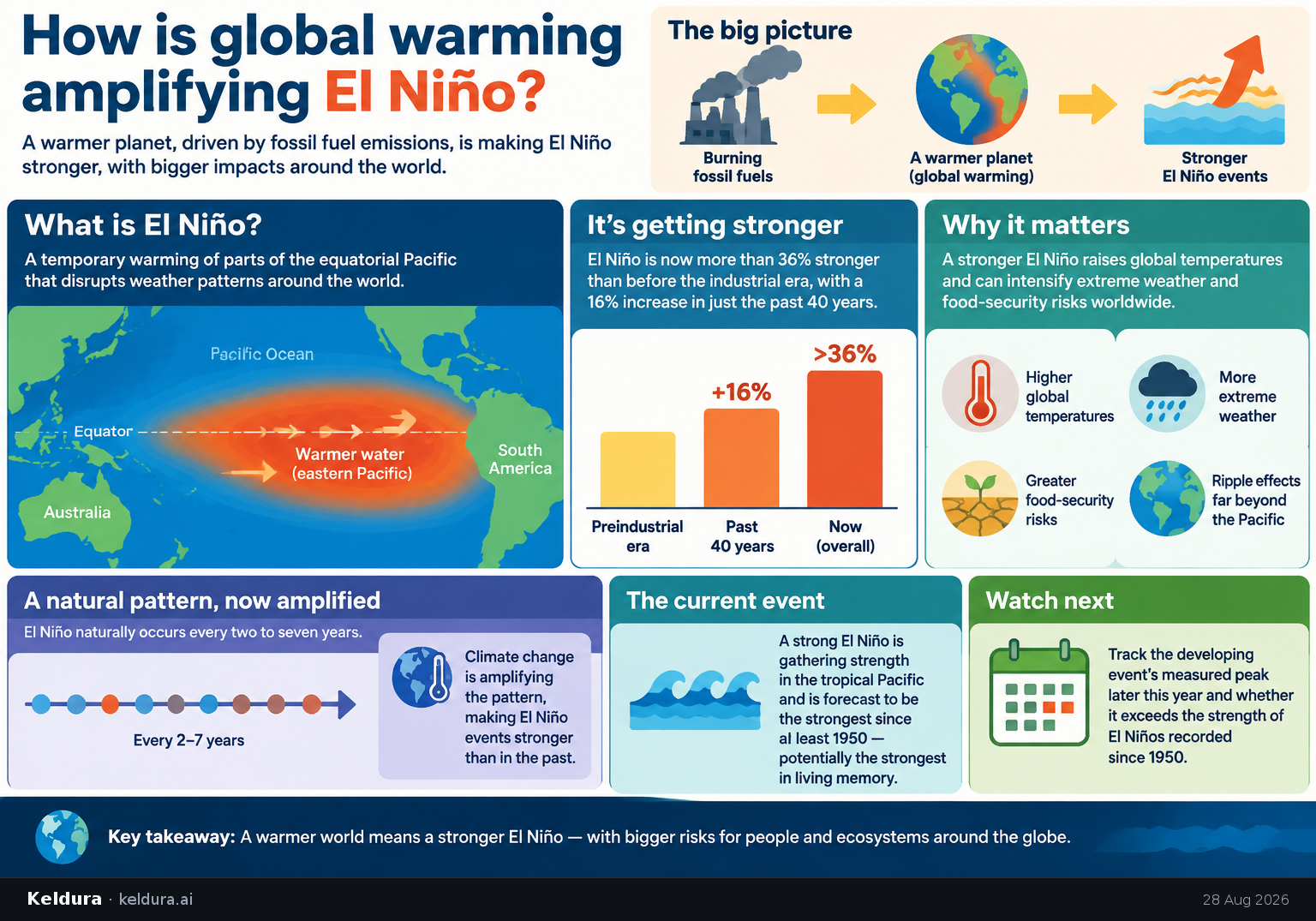
The research found El Niños are more than 36% stronger than before the industrial era, including a 16% increase in the past 40 years.[3] El Niño naturally occurs every two to seven years when the eastern tropical Pacific warms, but the new study provides evidence that fossil-fuel-driven planetary heating is amplifying the pattern.[4][5]
Why it matters: Because El Niño shifts weather around the world and raises global temperatures, a stronger baseline pattern can intensify extreme-event and food-security risks far beyond the tropical Pacific.[3][4]
Key insights: El Niño is a temporary warming of parts of the equatorial Pacific that disrupts weather patterns worldwide.[3] | The latest event is forecast to become the strongest since at least 1950 and potentially the strongest in living memory.[4][6] | The findings address a long-running scientific debate over whether El Niño’s severity is influenced by climate change rather than remaining entirely natural.[5] | The measured strengthening has accelerated, with a 16% increase occurring in only the past four decades.[3]
Cheatsheet facts: What changed: Researchers quantified El Niño as more than 36% stronger than in the preindustrial era, with a 16% rise in the past 40 years.[3] | Why now: The study arrived as a strong El Niño gathers strength in the tropical Pacific and is forecast to challenge historical records.[3][6] | Watch next: The developing event’s measured peak later this year and whether it exceeds the strength of El Niños recorded since 1950.[4][6]
X copy pack
Edition complete
You've reached the end of this edition.
[3] El Ninos are getting stronger and study says it's because of climate change | AP News — apnews.com[4] El Niño climate patterns supercharged by burning of fossil fuels, study finds | El Niño southern oscillation | The Guardian — theguardian.com[5] El Niño is more intense because of climate change, study finds — nbcnews.com[6] El Niño events are becoming stronger as the world warms | CNN — cnn.comPost to X