AfD victory tests Germany’s firewall against the far right
The Alternative for Germany won 43.8% of the vote in Saxony-Anhalt’s state election and finished three seats short of an outright majority, according to preliminary results.[4] The AfD is approaching other parties and individual legislators for support, despite the refusal of most German parties to…
The Alternative for Germany won 43.8% of the vote in Saxony-Anhalt’s state election and finished three seats short of an outright majority, according to preliminary results.[4] The AfD is approaching other parties and individual legislators for support, despite the refusal of most German parties to work with it.[4]
Why it matters: The result puts unprecedented pressure on Germany’s political firewall against the AfD and could determine whether the party enters state-level power or whether Saxony-Anhalt faces political deadlock and potentially another election.[4]
Key insights: AfD deputy parliamentary leader Beatrix von Storch argued that the result requires other parties to enter talks with the party.[4] | Saxony-Anhalt AfD leader Ulrich Siegmund said discussions began on election night and could take days or weeks.[4] | Chancellor Friedrich Merz described the result as “seismic” and said it had implications for both Germany and his own party.[4]
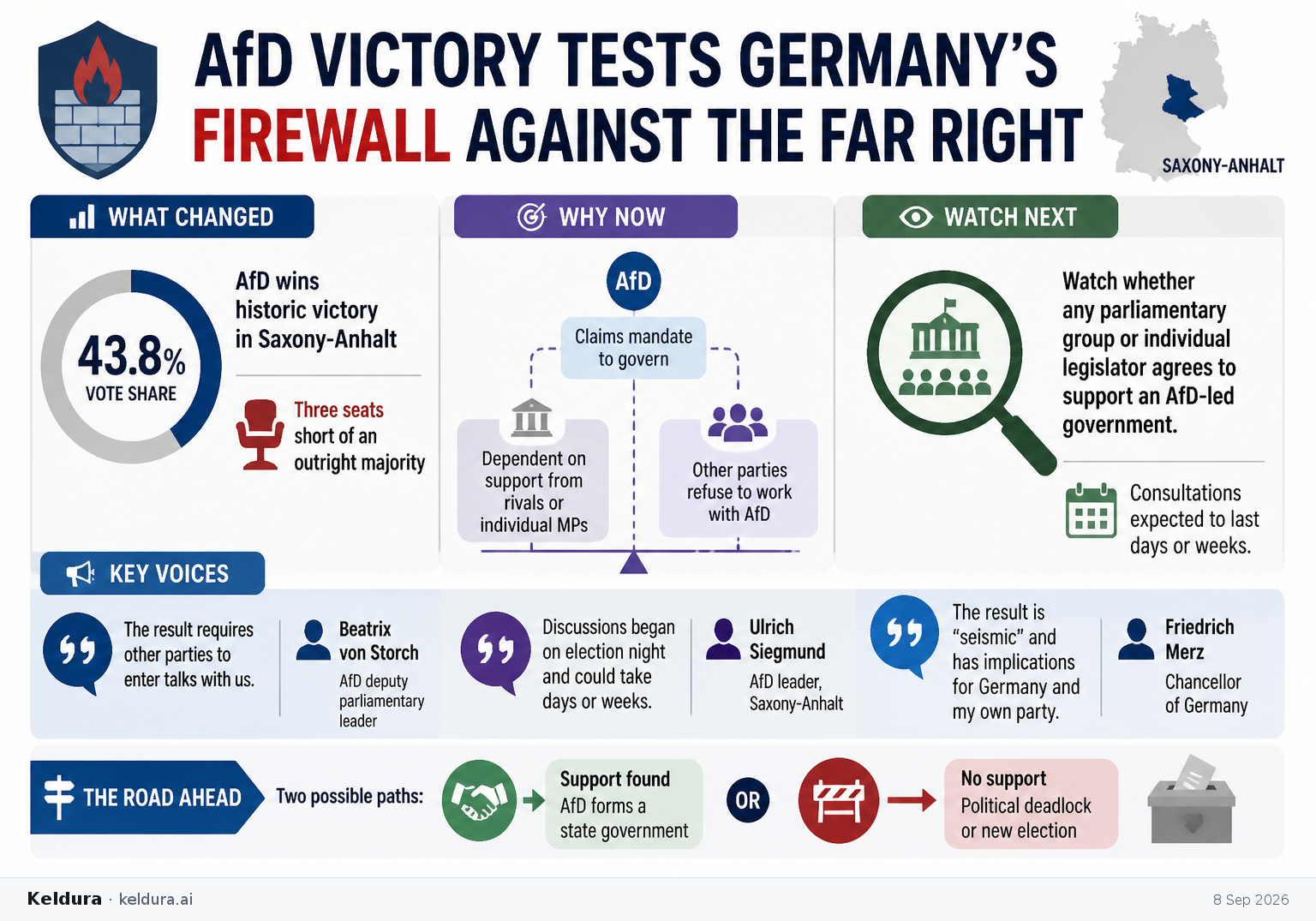
Cheatsheet facts: What changed: The AfD secured a historic state-election victory with 43.8% but lacks three seats for an outright majority.[4] | Why now: The result gives the AfD a claimed mandate to govern while leaving it dependent on support from political rivals or individual MPs.[4] | Watch next: Watch whether any parliamentary group or individual legislator agrees to support an AfD-led government during consultations expected to last days or weeks.[4]
The Alternative for Germany won 43.8% of the vote in Saxony-Anhalt’s state election and finished three seats short of an outright majority, according to preliminary results.[4] The AfD is approaching other parties and individual legislators for support, despite the refusal of most German parties to work with it.[4]
Why it matters: The result puts unprecedented pressure on Germany’s political firewall against the AfD and could determine whether the party enters state-level power or whether Saxony-Anhalt faces political deadlock and potentially another election.[4]
Key insights: AfD deputy parliamentary leader Beatrix von Storch argued that the result requires other parties to enter talks with the party.[4] | Saxony-Anhalt AfD leader Ulrich Siegmund said discussions began on election night and could take days or weeks.[4] | Chancellor Friedrich Merz described the result as “seismic” and said it had implications for both Germany and his own party.[4]
Cheatsheet facts: What changed: The AfD secured a historic state-election victory with 43.8% but lacks three seats for an outright majority.[4] | Why now: The result gives the AfD a claimed mandate to govern while leaving it dependent on support from political rivals or individual MPs.[4] | Watch next: Watch whether any parliamentary group or individual legislator agrees to support an AfD-led government during consultations expected to last days or weeks.[4]
X copy pack
Edition complete
You've reached the end of this edition.