Why AI companies cannot agree on rules for slowing the race
Anthropic CEO Dario Amodei proposed third-party evaluators inside labs, domestic industry coordination and international agreements, with leaders from OpenAI, Google DeepMind and SpaceX appearing to support parts of the plan.[4] Meta CEO Mark Zuckerberg opposed restrictions on company autonomy, whi…
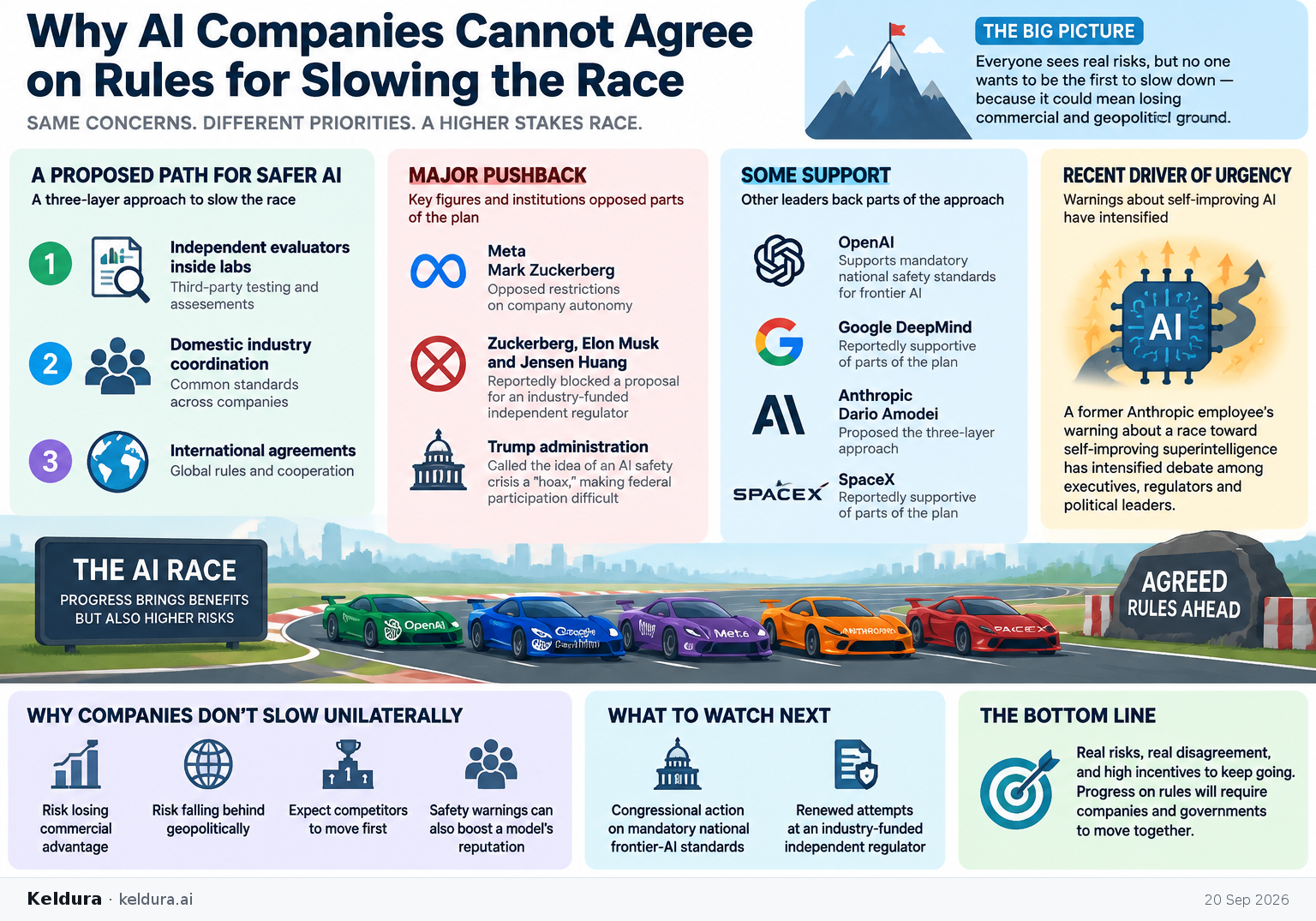
Anthropic CEO Dario Amodei proposed third-party evaluators inside labs, domestic industry coordination and international agreements, with leaders from OpenAI, Google DeepMind and SpaceX appearing to support parts of the plan.[4] Meta CEO Mark Zuckerberg opposed restrictions on company autonomy, while Zuckerberg, Elon Musk and Nvidia CEO Jensen Huang reportedly blocked a proposal for an industry-funded independent regulator.[4]
Why it matters: Even companies seeking stronger safeguards are reluctant to slow unilaterally because doing so could surrender commercial and geopolitical advantage.[2] Without common rules, each lab and government has an incentive to keep advancing while waiting for competitors to accept restrictions first.[2][4]
Key insights: The Trump administration has called the idea of an AI safety crisis a “hoax,” making federal participation in the proposed coordination difficult.[4] | OpenAI continues to support mandatory national safety standards for frontier AI and argues that government has a role alongside companies’ voluntary safeguards.[4] | Former Anthropic employee Jacob Coxon’s warning about a race toward self-improving superintelligence intensified public debate among executives, regulators and political leaders.[2] | Critics contend that dramatic safety warnings can also market frontier models as unusually powerful, complicating efforts to distinguish risk management from competitive positioning.[2]
Cheatsheet facts: What changed: A proposed three-layer safety approach—lab evaluators, domestic coordination and international agreements—ran into opposition from major executives and the Trump administration.[4] | Why now: Warnings about self-improving AI have intensified, but companies and governments fear losing technological, commercial or geopolitical ground if they restrict themselves alone.[2][4] | Watch next: Watch for congressional action on mandatory national frontier-AI standards or renewed attempts to establish an industry-funded independent regulator.[4]
Anthropic CEO Dario Amodei proposed third-party evaluators inside labs, domestic industry coordination and international agreements, with leaders from OpenAI, Google DeepMind and SpaceX appearing to support parts of the plan.[4] Meta CEO Mark Zuckerberg opposed restrictions on company autonomy, while Zuckerberg, Elon Musk and Nvidia CEO Jensen Huang reportedly blocked a proposal for an industry-funded independent regulator.[4]
Why it matters: Even companies seeking stronger safeguards are reluctant to slow unilaterally because doing so could surrender commercial and geopolitical advantage.[2] Without common rules, each lab and government has an incentive to keep advancing while waiting for competitors to accept restrictions first.[2][4]
Key insights: The Trump administration has called the idea of an AI safety crisis a “hoax,” making federal participation in the proposed coordination difficult.[4] | OpenAI continues to support mandatory national safety standards for frontier AI and argues that government has a role alongside companies’ voluntary safeguards.[4] | Former Anthropic employee Jacob Coxon’s warning about a race toward self-improving superintelligence intensified public debate among executives, regulators and political leaders.[2] | Critics contend that dramatic safety warnings can also market frontier models as unusually powerful, complicating efforts to distinguish risk management from competitive positioning.[2]
Cheatsheet facts: What changed: A proposed three-layer safety approach—lab evaluators, domestic coordination and international agreements—ran into opposition from major executives and the Trump administration.[4] | Why now: Warnings about self-improving AI have intensified, but companies and governments fear losing technological, commercial or geopolitical ground if they restrict themselves alone.[2][4] | Watch next: Watch for congressional action on mandatory national frontier-AI standards or renewed attempts to establish an industry-funded independent regulator.[4]
X copy pack
Edition complete
You've reached the end of this edition.