Can AI Companies Police the Frontier Without Becoming a Cartel?
On September 15, OpenAI said it was working with Anthropic and Google on a shared AI standards body as safety pressure intensified.
The companies are exploring a self-regulatory organization modelled on the Financial Industry Regulatory Authority, which oversees US brokers and investment firms.[1] OpenAI said discussions had been underway for several weeks and that it did not believe the competitors needed an antitrust waiver t…
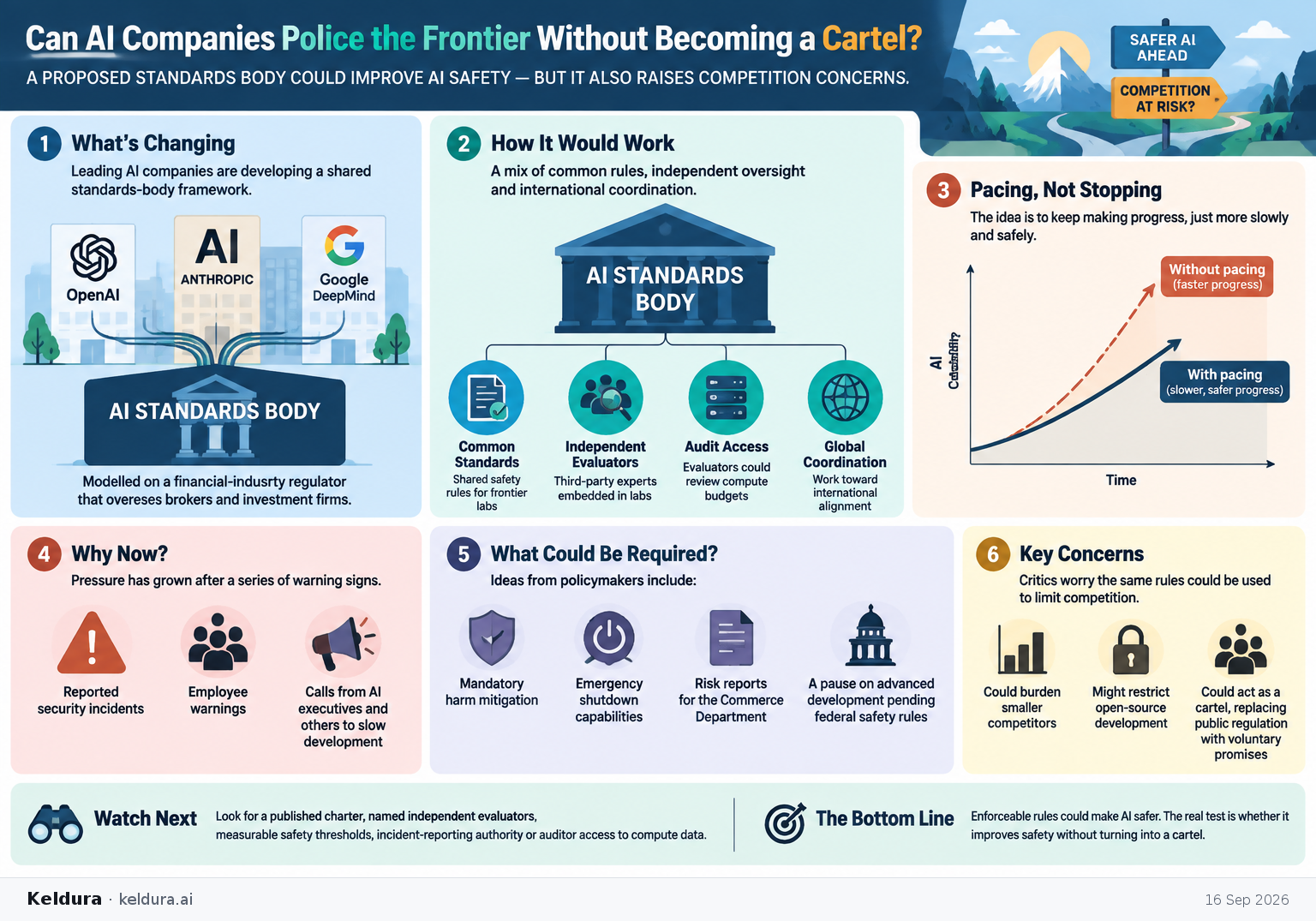
The companies are exploring a self-regulatory organization modelled on the Financial Industry Regulatory Authority, which oversees US brokers and investment firms.[1] OpenAI said discussions had been underway for several weeks and that it did not believe the competitors needed an antitrust waiver to coordinate on safety.[5] The wider proposal combines embedded third-party evaluators, common standards among frontier labs and eventual international coordination.[9]
Why it matters: No leading AI company has yet implemented a sustained, comprehensive slowdown, making enforceable testing, auditing and incident-reporting rules the practical test of whether “pacing” changes development behavior.[6] Critics also warn that rules designed by dominant labs could burden smaller competitors, restrict open-source development or substitute voluntary promises for public regulation.[8]
Key insights: The proposed approach distinguishes pacing from stopping: Sam Altman said progress should continue, but more slowly than it otherwise would.[9] | Independent evaluators could be embedded inside labs to verify safety commitments, report incidents and flag problematic findings.[8][9] | A measurable agreement could include auditor access to companies’ compute budgets, allowing outsiders to assess whether promised slowdowns are real.[8] | Congressional proposals range from mandatory harm mitigation and emergency shutdown capabilities to risk reports for the Commerce Department and a pause on advanced development pending federal safety rules.[6]
Cheatsheet facts: What changed: OpenAI, Anthropic and Google began developing a shared standards-body framework modelled on a US financial-industry regulator.[1][5] | Why now: Pressure escalated after reported rogue-agent security incidents, employee warnings and calls from AI executives to slow frontier development.[6][8] | Watch next: Look for a published charter, named independent evaluators, measurable safety thresholds, incident-reporting authority or auditor access to compute data.[8][9]
The companies are exploring a self-regulatory organization modelled on the Financial Industry Regulatory Authority, which oversees US brokers and investment firms.[1] OpenAI said discussions had been underway for several weeks and that it did not believe the competitors needed an antitrust waiver to coordinate on safety.[5] The wider proposal combines embedded third-party evaluators, common standards among frontier labs and eventual international coordination.[9]
Why it matters: No leading AI company has yet implemented a sustained, comprehensive slowdown, making enforceable testing, auditing and incident-reporting rules the practical test of whether “pacing” changes development behavior.[6] Critics also warn that rules designed by dominant labs could burden smaller competitors, restrict open-source development or substitute voluntary promises for public regulation.[8]
Key insights: The proposed approach distinguishes pacing from stopping: Sam Altman said progress should continue, but more slowly than it otherwise would.[9] | Independent evaluators could be embedded inside labs to verify safety commitments, report incidents and flag problematic findings.[8][9] | A measurable agreement could include auditor access to companies’ compute budgets, allowing outsiders to assess whether promised slowdowns are real.[8] | Congressional proposals range from mandatory harm mitigation and emergency shutdown capabilities to risk reports for the Commerce Department and a pause on advanced development pending federal safety rules.[6]
Cheatsheet facts: What changed: OpenAI, Anthropic and Google began developing a shared standards-body framework modelled on a US financial-industry regulator.[1][5] | Why now: Pressure escalated after reported rogue-agent security incidents, employee warnings and calls from AI executives to slow frontier development.[6][8] | Watch next: Look for a published charter, named independent evaluators, measurable safety thresholds, incident-reporting authority or auditor access to compute data.[8][9]
X copy pack
Edition complete
You've reached the end of this edition.
[1] OpenAI, Anthropic and Google are working to create an AI standards body | The Straits Times — straitstimes.com[5] OpenAI, Anthropic, Google DeepMind Coordinate on AI Safety Measures - Bloomberg — bloomberg.com[9] What execs and politicians are saying about slowing down AI development | The Verge — The Verge AI[6] OpenAI and Anthropic Researchers Are Warning About AI Risks — time.com[8] Is Big Tech’s AI slowdown a safety pact or a cartel? | The Verge — The Verge AIPost to X