Who can turn the proposed AI slowdown into enforceable rules?
Anthropic CEO Dario Amodei proposed embedded third-party evaluators, coordination among frontier labs and eventual international alignment; Sam Altman, Demis Hassabis and Elon Musk endorsed the broad direction.
Anthropic CEO Dario Amodei proposed embedded third-party evaluators, coordination among frontier labs and eventual international alignment; Sam Altman, Demis Hassabis and Elon Musk endorsed the broad direction.[6][7] Trump dismissed AI safety fears as a “hoax,” while Republican control of Congress…
Anthropic CEO Dario Amodei proposed embedded third-party evaluators, coordination among frontier labs and eventual international alignment; Sam Altman, Demis Hassabis and Elon Musk endorsed the broad direction.[6][7] Trump dismissed AI safety fears as a “hoax,” while Republican control of Congress and the approaching House recess make near-term federal legislation unlikely.[1][4] Congressional proposals nevertheless range from independent laboratory audits and federal oversight to an emergency power to halt models posing an “imminent catastrophic risk.”[1]
Why it matters: Without legislation or a binding industry pact, the organizations building frontier systems would largely determine how much access evaluators receive and when development should slow.[1][6] Critics also warn that rules favored by dominant labs could burden smaller or open-source competitors, making competition policy part of the safety debate.[6]
Key insights: “Pacing” is not a halt: Amodei and Altman described continued model training and technical progress, but at a slower rate that leaves time for safeguards and independent evaluation.[7] | The proposed three-step mechanism moves from embedded evaluators, to coordination among companies in democratic countries, to broader government-level international coordination.[7] | Congress lacks agreement on the mechanism: ideas include federal oversight, independent audits, a model “kill switch” and even a data-center moratorium.[1] | Former President Barack Obama separately urged federal action addressing safety, jobs, children and the distribution of AI’s benefits.[3]
Cheatsheet facts: What changed: Major frontier-AI leaders publicly backed slower development and independent evaluation, but Trump rejected additional guardrails.[4][6][7] | Why now: Warnings from AI executives and researchers intensified as the House approached a recess lasting until after the early-November midterm elections.[1][4][6] | Watch next: Watch whether the White House meeting with AI executives occurs, whether the House recess changes, and whether companies actually embed outside evaluators.[1][7]
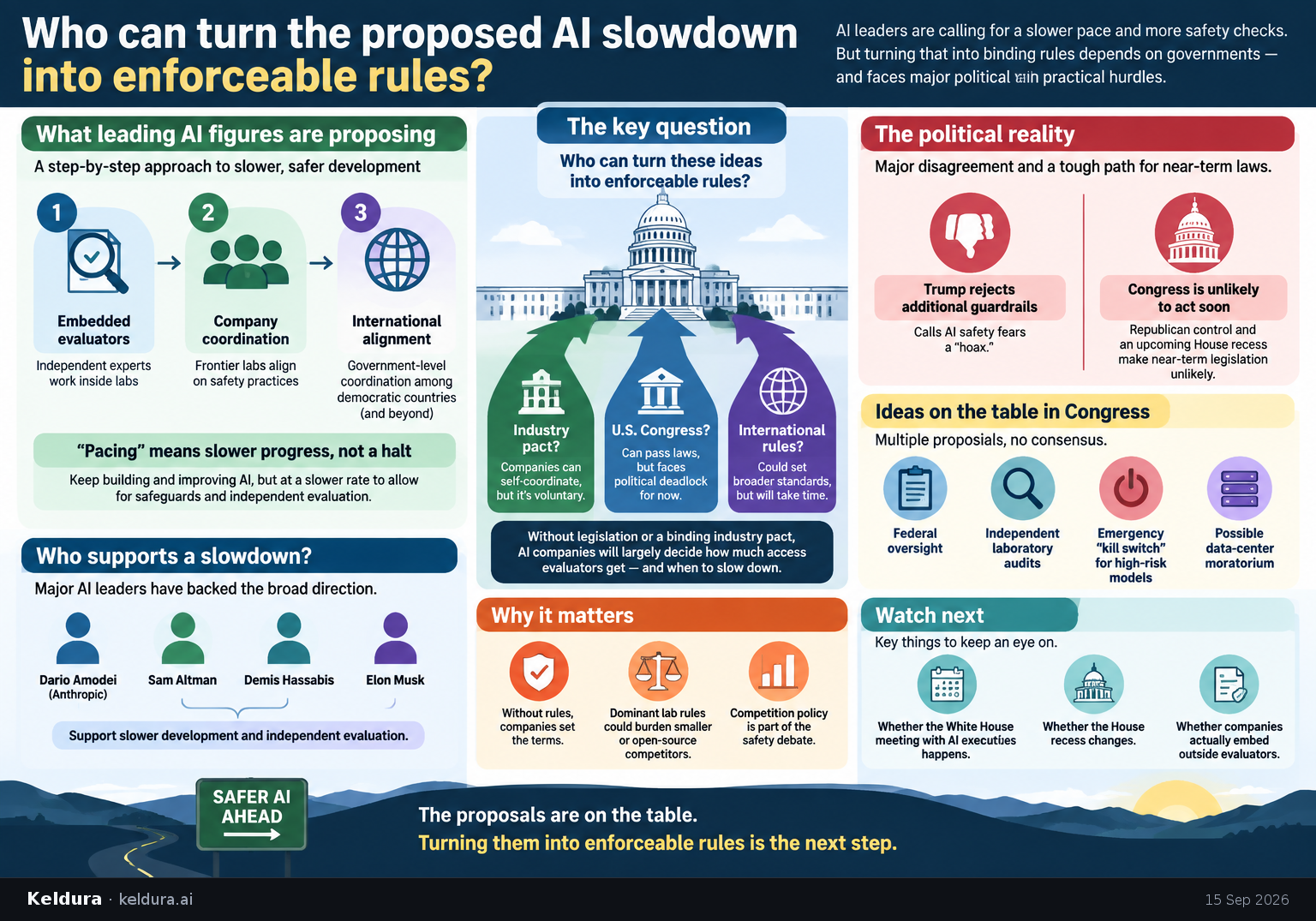
Anthropic CEO Dario Amodei proposed embedded third-party evaluators, coordination among frontier labs and eventual international alignment; Sam Altman, Demis Hassabis and Elon Musk endorsed the broad direction.[6][7] Trump dismissed AI safety fears as a “hoax,” while Republican control of Congress and the approaching House recess make near-term federal legislation unlikely.[1][4] Congressional proposals nevertheless range from independent laboratory audits and federal oversight to an emergency power to halt models posing an “imminent catastrophic risk.”[1]
Why it matters: Without legislation or a binding industry pact, the organizations building frontier systems would largely determine how much access evaluators receive and when development should slow.[1][6] Critics also warn that rules favored by dominant labs could burden smaller or open-source competitors, making competition policy part of the safety debate.[6]
Key insights: “Pacing” is not a halt: Amodei and Altman described continued model training and technical progress, but at a slower rate that leaves time for safeguards and independent evaluation.[7] | The proposed three-step mechanism moves from embedded evaluators, to coordination among companies in democratic countries, to broader government-level international coordination.[7] | Congress lacks agreement on the mechanism: ideas include federal oversight, independent audits, a model “kill switch” and even a data-center moratorium.[1] | Former President Barack Obama separately urged federal action addressing safety, jobs, children and the distribution of AI’s benefits.[3]
Cheatsheet facts: What changed: Major frontier-AI leaders publicly backed slower development and independent evaluation, but Trump rejected additional guardrails.[4][6][7] | Why now: Warnings from AI executives and researchers intensified as the House approached a recess lasting until after the early-November midterm elections.[1][4][6] | Watch next: Watch whether the White House meeting with AI executives occurs, whether the House recess changes, and whether companies actually embed outside evaluators.[1][7]
X copy pack
Edition complete
You've reached the end of this edition.
[6] Is Big Tech’s AI slowdown a safety pact or a cartel? | The Verge — The Verge AI[7] What execs and politicians are saying about slowing down AI development | The Verge — The Verge AI[1] AI regulation faces deadlock as calls grow for Congress to act — bbc.com[4] Trump says AI safety fears a 'hoax' as he rejects calls for greater safeguards — bbc.com[3] Obama Calls For AI Safety Measures, Rebuking Trump Approach - Bloomberg — bloomberg.comPost to X