Amazon-backed Texas power plant highlights AI’s emissions burden
Amazon is investing in a gas-burning power plant intended primarily to supply a new data center in Pecos County, Texas, initially without connecting to the state power grid.[3] The proposed GW Ranch facility would use 35 natural-gas turbines to provide 7.65 gigawatts and has a Texas permit allowing…
Amazon is investing in a gas-burning power plant intended primarily to supply a new data center in Pecos County, Texas, initially without connecting to the state power grid.[3] The proposed GW Ranch facility would use 35 natural-gas turbines to provide 7.65 gigawatts and has a Texas permit allowing emissions of up to 33 million tons of CO2.[3]
Why it matters: Even emissions well below the permitted ceiling could undermine Amazon’s Climate Pledge as its emissions have already risen for several years amid growing AI demand.[3] The project also reflects a wider trend in which Meta, Google, and other technology companies are developing power generation that includes gas, coal, and other non-renewable sources for AI data centers.[3]
Key insights: The permitted ceiling exceeds the emissions of the country’s largest coal plant, although power plants rarely emit the full amount their permits allow.[3] | Amazon confirmed that it purchased the data-center site and plans to buy power from GW Ranch.[3] | Amazon says the on-site generation will avoid increasing electricity costs for Texas families and is designed to transition to grid-connected service when interconnection timelines permit.[3] | The company says it is exploring on-site solar and battery storage while planning non-potable water sources and cooling technology intended to minimize water consumption.[3]
Cheatsheet facts: What changed: A Texas permit allows the Amazon-backed GW Ranch power project to emit up to 33 million tons of CO2 while supplying a new data center.[3] | Why now: Electricity demand from AI data centers has surged, prompting technology companies to pursue dedicated generation, including fossil-fuel plants.[3] | Watch next: Watch whether the campus adds solar and battery storage and when its power supply transitions from on-site generation to grid-connected service.[3]
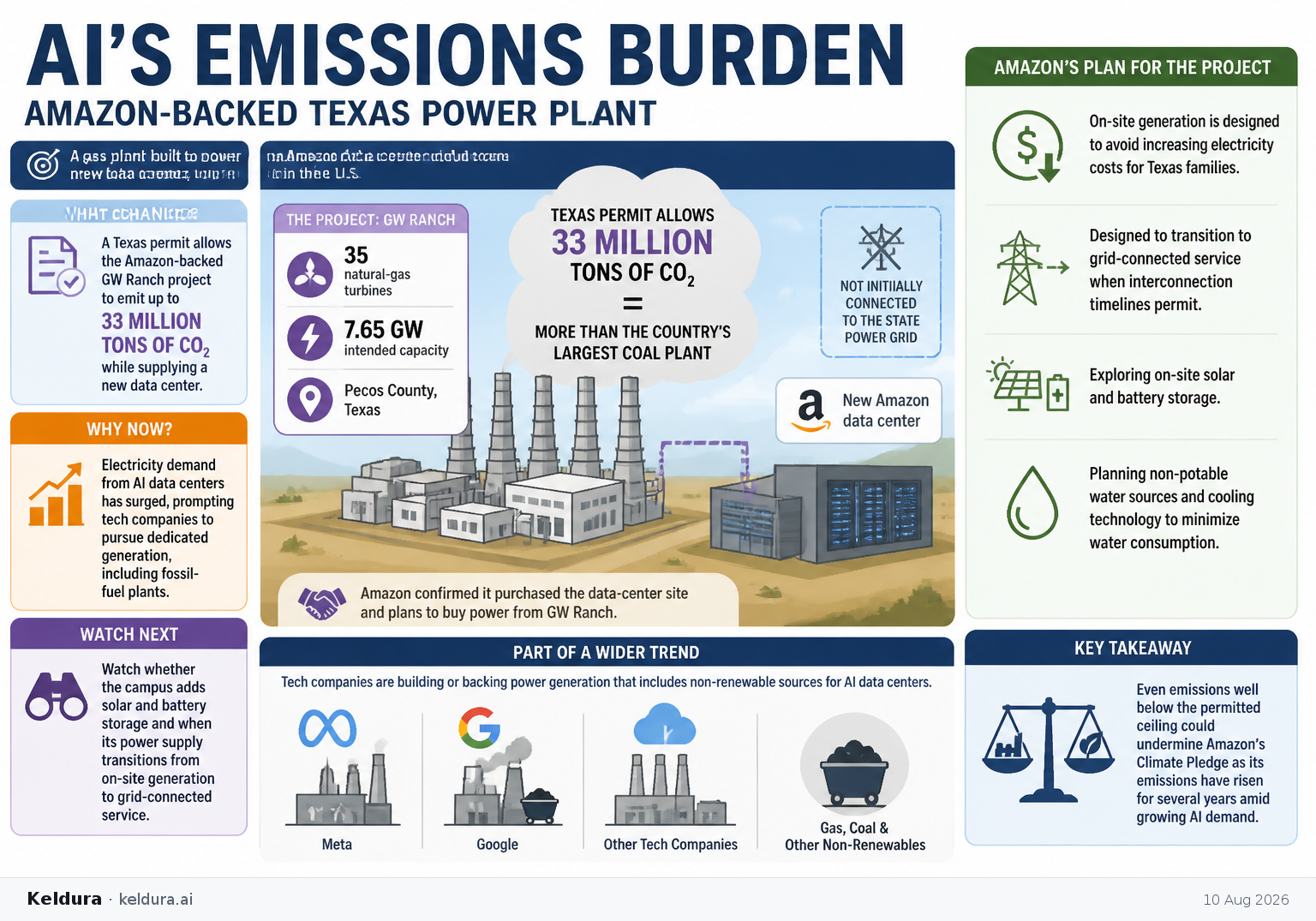
Amazon is investing in a gas-burning power plant intended primarily to supply a new data center in Pecos County, Texas, initially without connecting to the state power grid.[3] The proposed GW Ranch facility would use 35 natural-gas turbines to provide 7.65 gigawatts and has a Texas permit allowing emissions of up to 33 million tons of CO2.[3]
Why it matters: Even emissions well below the permitted ceiling could undermine Amazon’s Climate Pledge as its emissions have already risen for several years amid growing AI demand.[3] The project also reflects a wider trend in which Meta, Google, and other technology companies are developing power generation that includes gas, coal, and other non-renewable sources for AI data centers.[3]
Key insights: The permitted ceiling exceeds the emissions of the country’s largest coal plant, although power plants rarely emit the full amount their permits allow.[3] | Amazon confirmed that it purchased the data-center site and plans to buy power from GW Ranch.[3] | Amazon says the on-site generation will avoid increasing electricity costs for Texas families and is designed to transition to grid-connected service when interconnection timelines permit.[3] | The company says it is exploring on-site solar and battery storage while planning non-potable water sources and cooling technology intended to minimize water consumption.[3]
Cheatsheet facts: What changed: A Texas permit allows the Amazon-backed GW Ranch power project to emit up to 33 million tons of CO2 while supplying a new data center.[3] | Why now: Electricity demand from AI data centers has surged, prompting technology companies to pursue dedicated generation, including fossil-fuel plants.[3] | Watch next: Watch whether the campus adds solar and battery storage and when its power supply transitions from on-site generation to grid-connected service.[3]
X copy pack
Edition complete
You've reached the end of this edition.